



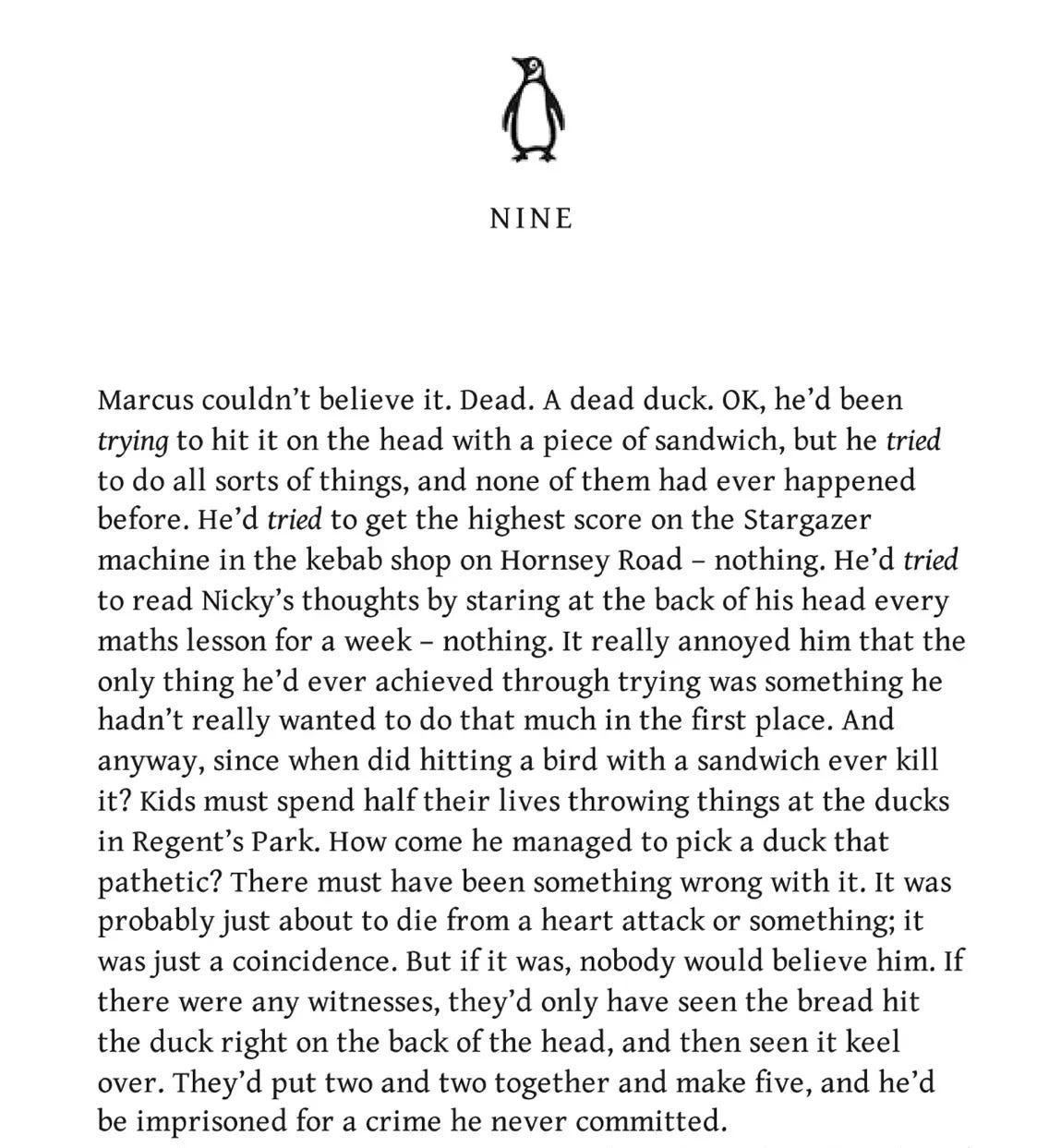
You can have your bright cold days in April and your worst of times, but I’ve taken the view that this remains the greatest opening to a chapter in the history of the English language. It is from Nick Hornby’s About a Boy, and involves a dead duck.
I’m almost certainly breaching copyright law at this point so let me just state — for the benefit of readers at Mishcon de Reya or Bird & Bird — that I’ve purchased the book in hardcover and paperback, seen the film in cinemas and got the DVD.
My interest is partly time travel. It was late summer 1999, something I know for a fact because Arsenal had just drawn Fiorentina in the Champions League group stage1 and a single scoop of stracciatella still cost 3,000 lire.
We were staying, as it happened, in Florence when I heard some disturbing sounds emanating from my parents’ bedroom. I rushed in to find my dad in bed, fully dressed, thank goodness, holding a book while seemingly having some sort of fit. In between sobs, he began to read aloud:
Marcus couldn’t believe it. Dead. A dead duck.
And then the uncontrollable laughter started up again and he had to admit defeat.
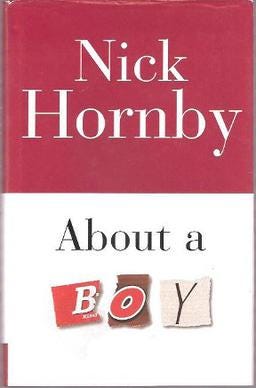
Before the holiday was over, he bequeathed the book to me. Which, on reflection, given its [spoiler alert] suicide attempts, drug use and sexual references, was perhaps a bit much for a ten-year-old. But it was the 1990s and grownups had only recently stopped giving toddlers plastic bags with which to entertain themselves.
And anyway, it wasn’t until I picked it up again many years later that I realised just how meaningful the book was to me.
Which one?
About a Boy is classic Hornby fare. Based within earshot of the Holloway Road, it's a witty, bittersweet story centred on an aimless, thirty-something man, Will, who befriends (in the amazingly non-creepy sense) a lonely 12-year-old boy, Marcus, after pretending to be a single father in order to pick up women.
The title is a play on “About a Girl”, the third track from Nirvana’s debut studio album, Bleach. Which makes sense, given that music is one of the central themes of Hornby’s writing, and the fact that the novel’s climax is set against the death of Kurt Cobain (which presumably explains why the film adaptation departs from the book, not least because licensing Nirvana’s music would have been prohibitively expensive).

But the title also functions as a description. The novel spends its entire length flitting between Marcus and Will, bringing their divergent coping strategies into sharper focus. The former is a pre-teen forced to grapple with grownup fears and challenges, while the latter is a 36-year-old in permanent adolescent, emotionally avoidant mode. The ‘boy’ in question could easily refer to either.
About Me
Now, it’s scarcely unique to see oneself reflected in (or at least to convince yourself of such a thing) in a character. But, somehow, on each subsequent reading, I see myself in both potential candidates for ‘Boy’. Partly because, as the film critic Mark Kermode said of all great coming of age stories:
It makes you think it’s about you. That I grew up in a completely different world in a different country in a different culture and a different gender, a different national whatever but I understand what that character is feeling. You take care of the specifics and the generalities will take care of themselves.
But also because I really do see myself in both. There’s Marcus, autistic-coded, devoid of agency and prone to treating everything from bullying kids to his mother’s depression as just the weather. And then there’s Will, with almost cartoonish levels of agency but with neither job nor obligations, seemingly untethered from anything with structural integrity.
And this is where things get truly spooky: he finds the British Museum painfully dull:
Was there a more boring place in the world than the British Museum? If there was, Will didn’t want to know about it. Pots. Coins, Jugs. Whole rooms full of plates. There had to be a point of exhibiting things, Will decided. Just because they were old, it didn’t mean they were necessarily interesting. Just because they’d survived didn’t mean you wanted to look at them.
The End
The book finishes hopefully enough. Well, not for Cobain, but at least for all the fictitious characters. Alright, not for the duck either, but all the fictitious human characters. Marcus has a bit more of a support structure and is going to be alright, while Will is learning to let others in. Even Fiona, Marcus’s downtrodden mother, might eventually get an evening off.
As for me, I’m still definitely one or both of the boys: time-rich and agency-poor or the other way around — depending on the hour of day and how the newsletter draft’s going.
Arsenal secured a terrific draw against Barcelona at the Nou Camp but the campaign was largely a disaster, with Gabriel Batistuta scoring a late winner at Wembley to send us out