


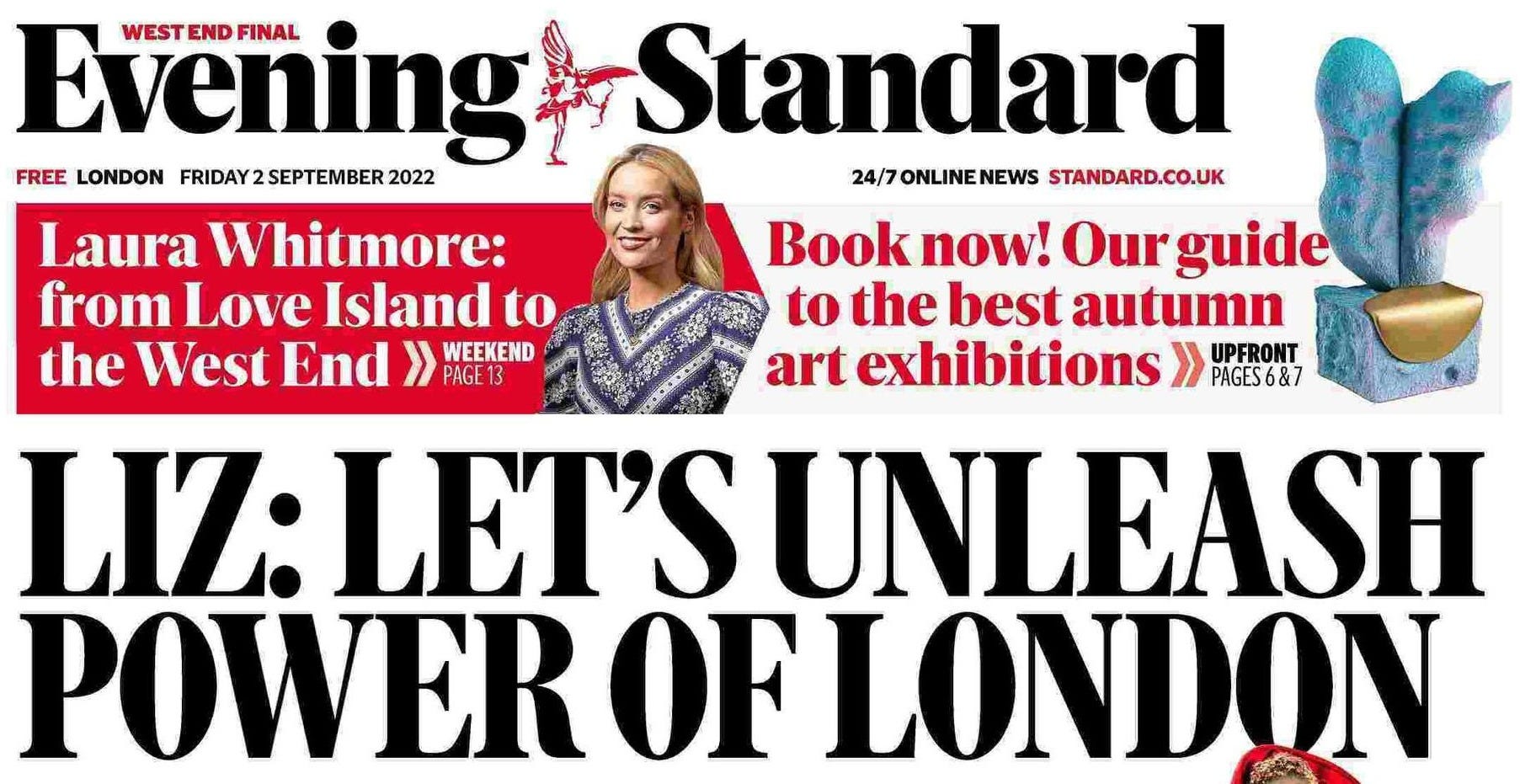
“Don’t worry, no one reads leaders.” These were the words Evening Standard editor Emily Sheffield said to me on my first day as the paper’s leader writer, presumably by way of reassurance. And, with notably rare exceptions (my mother, people writing long reads with titles like “Whatever happened to the Evening Standard?”), she was absolutely spot on.
Leader columns are something of an anachronism. Then again, so is any section of a newspaper, what with its puns, tiny fonts and news stories frequently overtaken by events before they even hit the shelves (or, for the baby boomers, get tossed onto the doorstep).
During its zenith, the Evening Standard published six editions a day1, acting as a sort of pre-internet rolling news source. And it more than held its own against the nationals. As editor of the Sunday Times, Andrew Neil would eagerly wait in his Wapping office for the first edition to drop, noting that “what it chose to make the page-one splash of its West End edition was invariably what the nationals ran with next day.”2
Where you lead, I will follow
The obvious question is: how can a newspaper, consisting of thinly sliced trees, take a view on anything? What generally happens is that the line gets hammered out at conference. The position is usually obvious, and generally determined by a combination of the predilections of the editor, proprietor and readership — though not necessarily in that order.
For instance, did The Sun endorse Labour ahead of the 1997 general election because Tony Blair travelled to Hayman Island, Australia, to meet Rupert Murdoch? Did he provide any specific assurances on the euro? Or did it have more to do with the fact that his party was 20 points ahead in the polls and the self-styled newspaper of the people couldn’t be seen to be backing such an obvious loser in John Major?
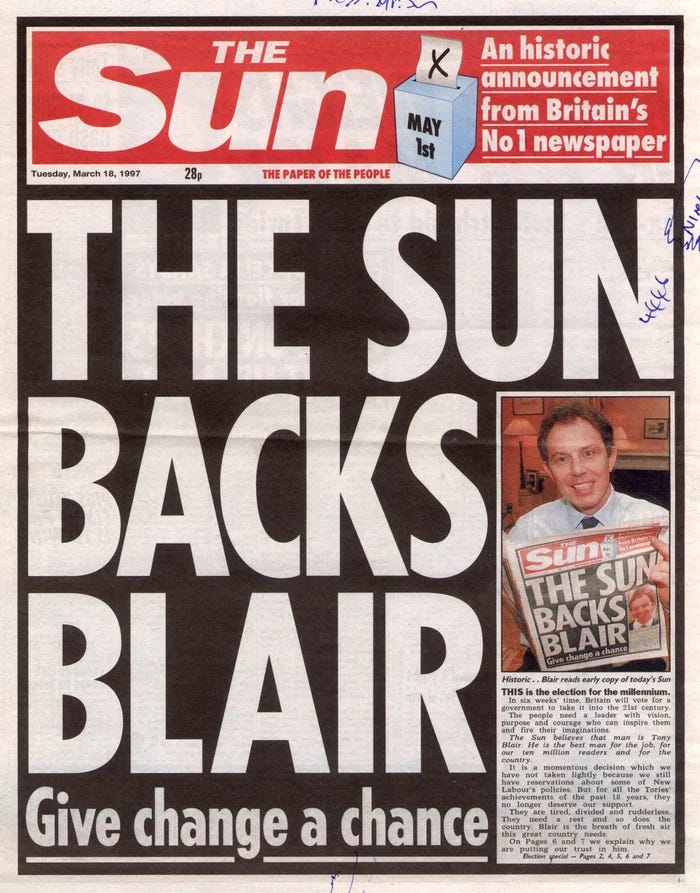
The specific leader is really oddly drafted, by the way. At one point, it suggests that the Tories have “all the right policies but all the wrong faces.” What the heck does that mean? For more, see this BBC Newsnight clip for how gloriously uncomfortable the paper’s editor, Stuart Higgins, felt about the whole thing.
Clearly, I am in no position to judge. As The Evening Standard’s leader writer and, later, chief leader writer — a title bump I negotiated in lieu of a pay rise which also masked the fact I was the only leader writer — while I was never put in a position to write a leader in favour of ivory dealing or encouraging toddlers to take up smoking, I did draft the one endorsing Liz Truss for Conservative Party leader and, consequently, prime minister.
For reasons I’m only too pleased to share, it remains one of my absolute favourites.
Truss issues
Regular readers may be aware that I’ve been fairly critical of Truss. There’s this:

And this:

To name but two. But one thing I learned from Melanie McDonagh, the doyenne of (extremely right-wing but beautifully crafted) leaders is to make them as close to your actual opinion as possible and wait to see how much the editor identifies and makes you take out.3 In that spirit, my 300 words comprised 80% “Guys, are we sure this is a good idea?” and a single paragraph actually doing the endorsing.
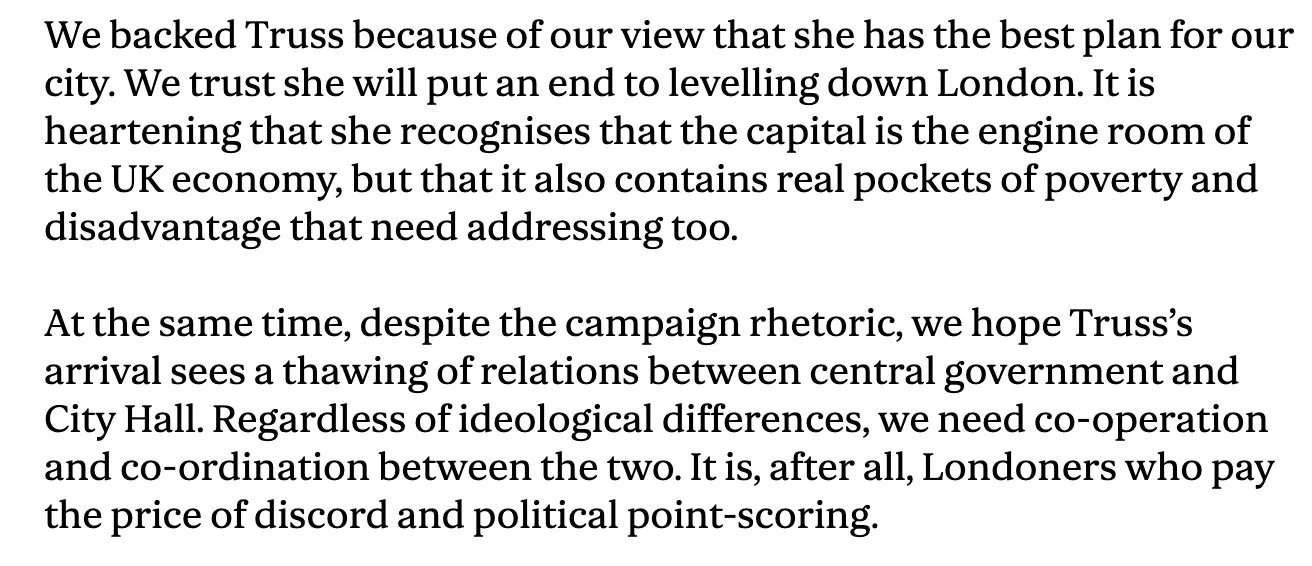
The plan was, if I may, a triumph. Obviously, no one, even in the spectacularly insular world of British journalism, was paying any attention to the Standard’s view. I’m not even sure why we felt the need to take one. Contrast that with the endorsement of Sadiq Khan for a third term as mayor in 2024, which:
1. Caused a bit of a stir, given the paper was historically a Tory-supporting one
2. Was at least an Earth-bound reflection of Khan’s record: doing very little in the first term before choosing to burn through political capital on the Ultra-low emission zone (Ulez) in pursuit of better air quality
Busted
Well, a triumph until The Independent’s chief political commentator (and Blairite-in-chief) John Rentoul shared a screenshot of the piece on Twitter, if memory serves me correctly (the website, now called X, is a sewer without a functioning search bar) pointing out that the endorsement was, erm, rather well hidden.
As it happened, Truss was gone within 50 days and so we never got to see what life might have been like under a prime minister that weird. And in any event, my overriding memory of her premiership is shaped more by the fact that the Standard’s comment editor went on holiday the week after the Queen died, I had to cover for him and it was a nightmare.
The last one being West End Final
I wouldn’t lash yourself too harshly over the Truss faux pas. Though I do recall my nose sniffing away badly when I saw her in the summer of ‘22 on the hustings with Rishi. His expressions said it all.
Times really do change. My parents and grandparents used to insist that in its heyday, ES’s reputation was both national & international. I once saw a pile in the Bournemouth station newsagents and got a bit puzzled. What other evening newspaper gave you closing share prices and offer a serious art critic like Brian Sewell? (His writing style, with its page long periods, made Cicero seem like a breeze!) And now all gone….