


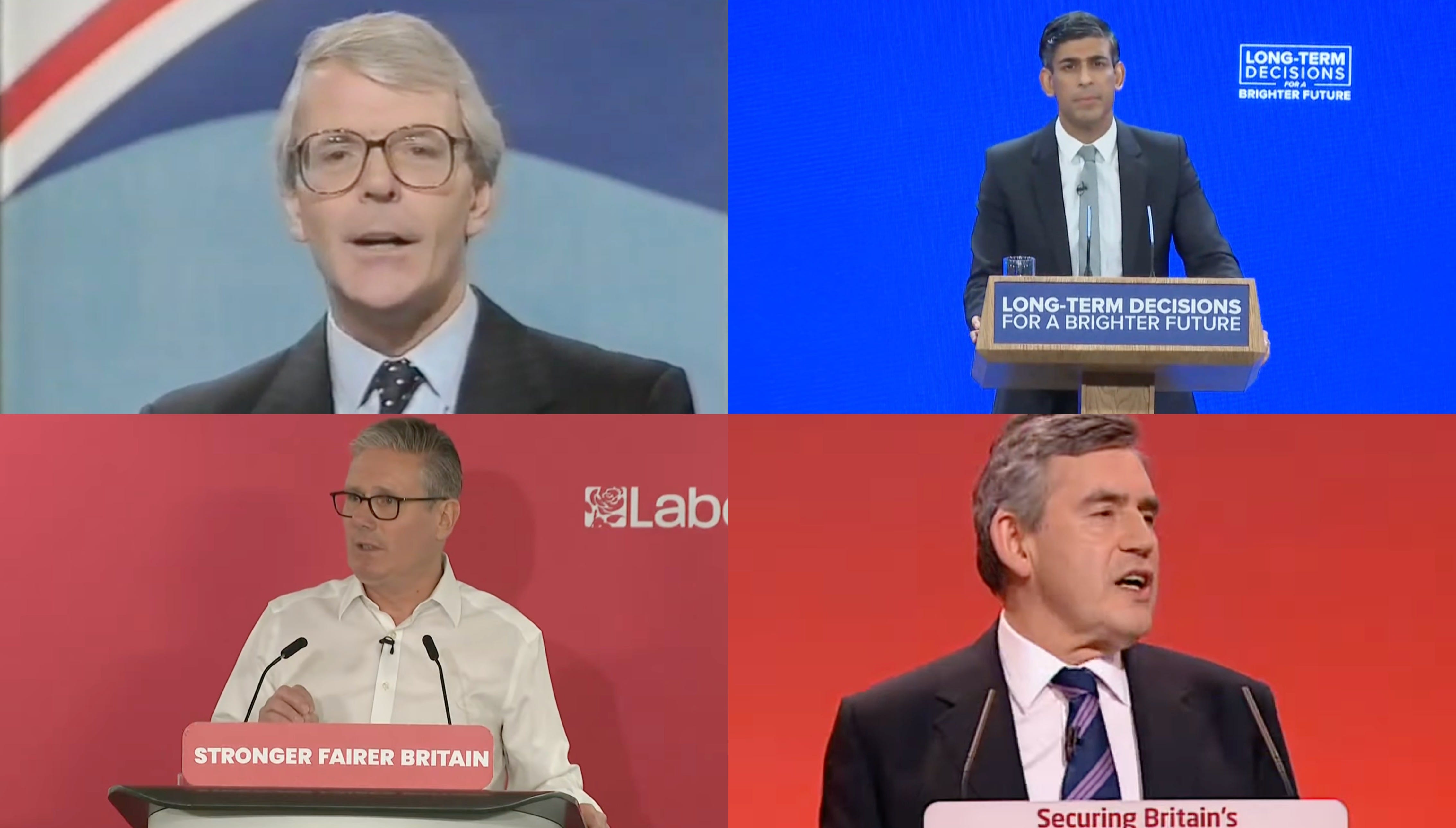
In the end, the prime minister got off lightly. A speech that really ought to have been remembered as the one that cancelled the northern leg of HS2 will instead be remembered as... alright, real talk: it won’t be remembered at all. But if it were to be remembered, it would be the one where Rishi Sunak declared he would end the ‘30 years of status quo’ in British politics.
To which, I’m going to be frightfully rude but I’ve got to ask: what status quo? Bear in mind this was the 2023 Conservative Party conference leader’s speech, so 30 years takes us neatly (a little too neatly, if you ask me) to 1993 and John Major’s Back to Basics debacle. And what did we get in the intervening three decades? A quick and dirty summary:
John Major: practical conservatism, moderate Euroscepticism and weak leadership.
Tony Blair: public service reform, radical constitutional modernisation and foreign policy adventurism.
Gordon Brown: that Gordon Brown should be prime minister.
David Cameron: fiscal austerity and Brexit.
Theresa May: industrial strategy, technocratic caution and Brexit-as-democratic-obligation.
Boris Johnson: ideological flexibility, political opportunism and levelling up.
Liz Truss: supply-side economics, anti-’Treasury orthodoxy’ and hahahahahaha

Now, granted, this does not quite match the ideological vicissitudes of the 1970s and 1980s, when policy could shift from support for the common ownership of the means of production, withdrawal from the European Economic Community and unilateral nuclear disarmament to monetarism, privatisation and anti-communism.
Still, the 1993-2023 period is not classic status quoism either.