


“Supply and demand!” That was the most common response my A-level economics teacher received, on telling strangers what she did for a living. Why are people so weird? Not least because this contravenes the single best piece of advice I have ever received.
That is: when someone tells you what they do for work, and you want to sound broadly sympathetic, don’t reply with the standard “that sounds so interesting.” First, because, let’s face it, it probably isn’t. And second, there’s a decent chance the other person doesn’t think so either. Instead, say “that sounds really challenging”.
Think about it. Whether you love or hate your job, we all get a serotonin boost from being told it sounds difficult. My only reticence in sharing this nugget is the distinct knowledge I have almost certainly deployed it at weddings, bar mitzvahs and first dates attended by subscribers to this newsletter.
So, if you are reading this and recall I once said this to you over canapés, I really did mean it.
High on their own supply
It’s not that supply and demand isn’t central to economics. Thanks to Donald Trump, we’re all getting a crash course in the concept. As of last year, indeed as of a couple of months ago, around 25% of the world’s seaborne oil trade and 19% of liquefied natural gas transited the Strait of Hormuz. As of April 2026, that number is, erm, lower.
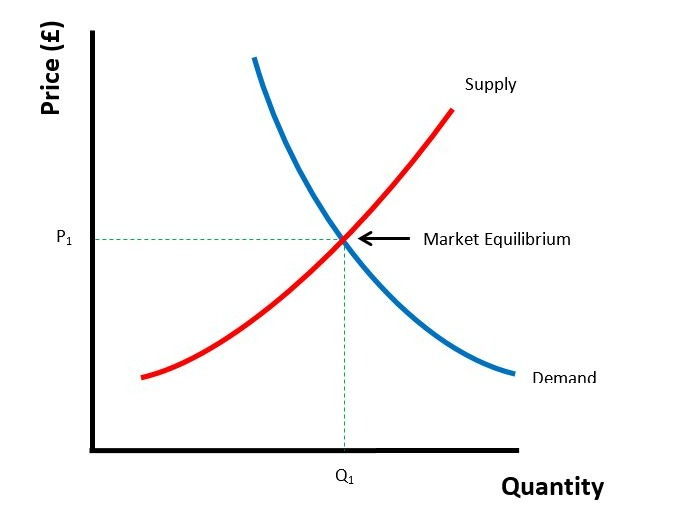
What happens next is reasonably straightforward: supply falls and so the price rises. This is a signal to consumers — the demand side of the equation — to buy less of the stuff. Not just petrol, of course, but everything that the oil supply chain touches, from food and plastics to holidays. But in reality, the law of supply and demand is about as heavily enforced as fare evasion on the Tube.

First, there is the question of price elasticity, which measures how sensitive consumers are to a given change in price. An extreme example would be addictive goods. Cigarette companies may be able to raise their prices without precipitating a fall in demand because their customers are physiologically dependent on their products. Close behind are sporting franchises — if Manchester United raises season ticket prices, are fans really going to nip across town to support City instead?
Then there’s the issue of supply. Sure, in an idealised market, higher prices should lead to more producers entering the market, moving the curve toward a new equilibrium. But the theory ignores short-term supply limits — producers can’t immediately increase output. It also assumes no panic buying on the part of consumers or interference by panicked politicians.
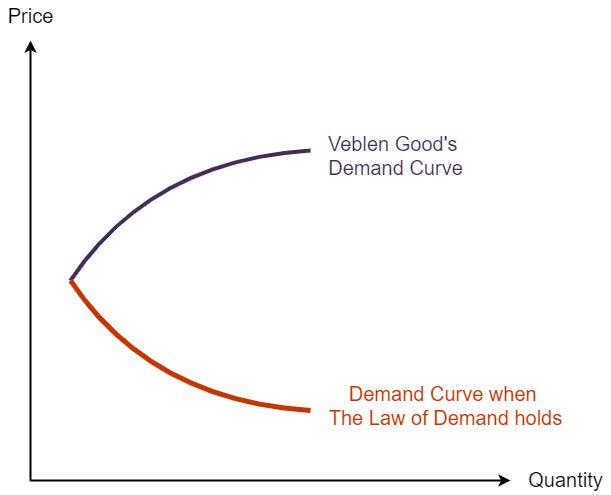
But by far my favourite exception is for the one type of goods that don’t just ignore the law of supply and demand, but actively flaunt it: Veblen goods.
Luxury is a state of mind
What is luxury — and why is it different to premium? This was a question raised by Ben Gilbert and David Rosenthal in a 2022 episode of Acquired, the podcast on business history and strategy, about LVMH. This is one of those situations where, even if you don’t have a pithy definition at your fingertips, you just know the difference.
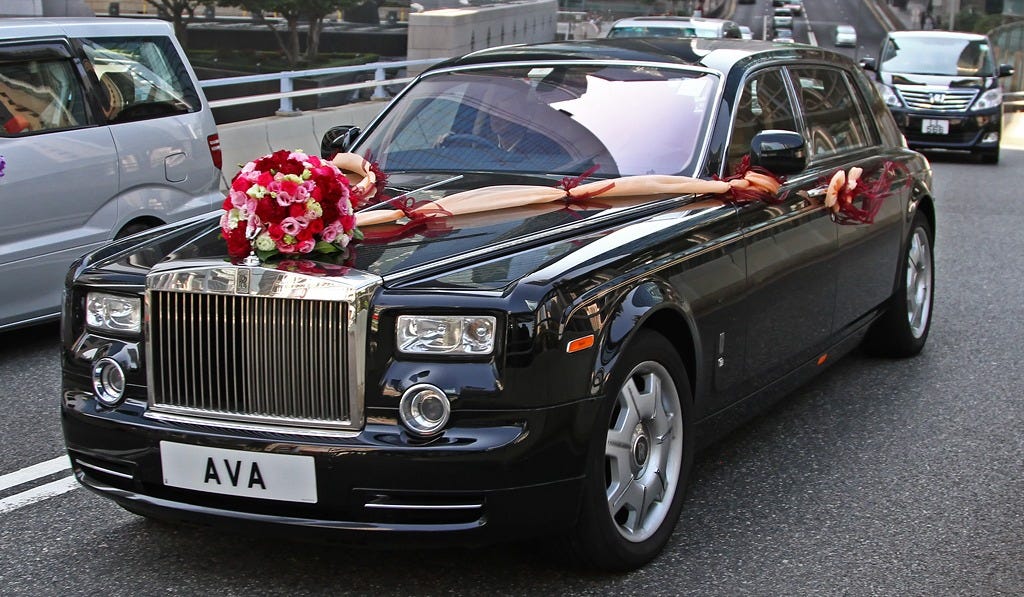
BMW is premium, but Ferrari is luxury. Ralph Lauren is premium, but Hermès is luxury. Sofitel is premium, but Mandarin Oriental is luxury. In short, premium means you’re paying more for higher quality. But luxury? It’s about paying more to make a statement about yourself. Without wishing to sound like ChatGPT, the price isn’t the signal — the conspicuous consumption is.

Which is where Thorstein Veblen comes in. The American economist observed that for certain goods, the demand curve is inverted. That is, an increase in price leads to an increase in demand. People want it because it’s expensive, not in spite of it. Owning the handbag or watch is a form of communication: look how wealthy I am, or how much taste I possess, or my access to exclusivity12.
An extreme example would be a work of high-end art, which has essentially zero utility or objective value. But practicality is for the merely well-off. Owning something completely useless or impractical is the signal that you’ve made it. I mean, a Ferrari in central London will not get you to your destination any faster, or even in greater comfort than a Ford Mondeo. That’s the point.
I think I find Veblen goods so satisfying (the concept, not the objects) as it sits at the intersection of economics, psychology and sociology. It demonstrates that while simple models assume rational actors seeking maximal utility, preferences are often social, value is at least partly constructed and demand can be identity-driven.
Perhaps Lines to Take needs to raise its prices.
The Acquired guys unearthed a great quote from The Luxury Strategy by Jean-Noël Kapferer and Vincent Bastien:
“Premium means pay more, get more in functional benefits. Luxury is elsewhere. It signals the capacity of the buyer to transcend needs, functions, or objective benefits. This is how luxury brands are different from premium or super premium brands. Beyond the experience, they bring creative power, heritage, and social distinction.”
It’s not only luxury goods that have a bit of Veblen about them. Lowering prices can hurt demand because of the price-quality heuristic. Think a £10 bottle of wine versus a £50 one. Or going onto Rightmove and wondering what’s wrong with a property that just had its second price reduction.
Legacy poll: I think we can reduce the options to three because foreign policy doctrines can be tossed aside in future due to changing circumstances. The others have a sense of…permanence.
Jack? No aviation angle, here? There is, you know: in the sense that in the world of travel, where prices fluctuate every second, what is the price of anything against which you are judging? Does it just become a feeling whether something is ok or not? Before our time, air routes had published fares, so discounts etc were transparent. Now? I’m sure you get emails like me which say “up to 52% off business & first class”. I ask senders what the heck does that mean? Please give me the original price for business LHR-SIN rtn, and your offer price now. Answer: line goes dead…
Economics was not my favourite A level subject…..
Anybody who understands economics—as you appear to Jack—has my admiration. That sounds seriously challenging! I have an engineering degree so knew a bit about logical thinking and complex maths. (Note deliberate use of past tense.) In my third year I took an option called management studies, which consisted of modules—not that we called them modules then—on sociology, statistics, and economics. I was floored. I had more or less got my head around differential calculus—think aerodynamics and fluid flow—but just could not understand the equations and interactions of economics. To this day I have no idea how whole societies become wealthier.