


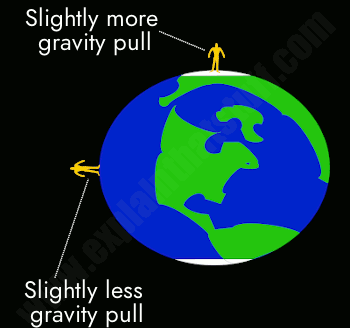
For a chunk of rock that weighs six trillion metric tonnes, spins at 465 metres per second and is home to the only known place in the universe to support life, Earth is really quite relatable. While famously not flat, our planet is not quite round either. It is, instead, an oblate spheroid — a fancy way of saying it bulges in the middle.
The reason for this is not actually all that interesting. The Earth’s rotation generates a centrifugal force which pushes mass outward — and this effect is strongest at the equator where the surface speed is fastest. The result? A diameter at the equator that is about the distance of a marathon larger than pole-to-pole1.
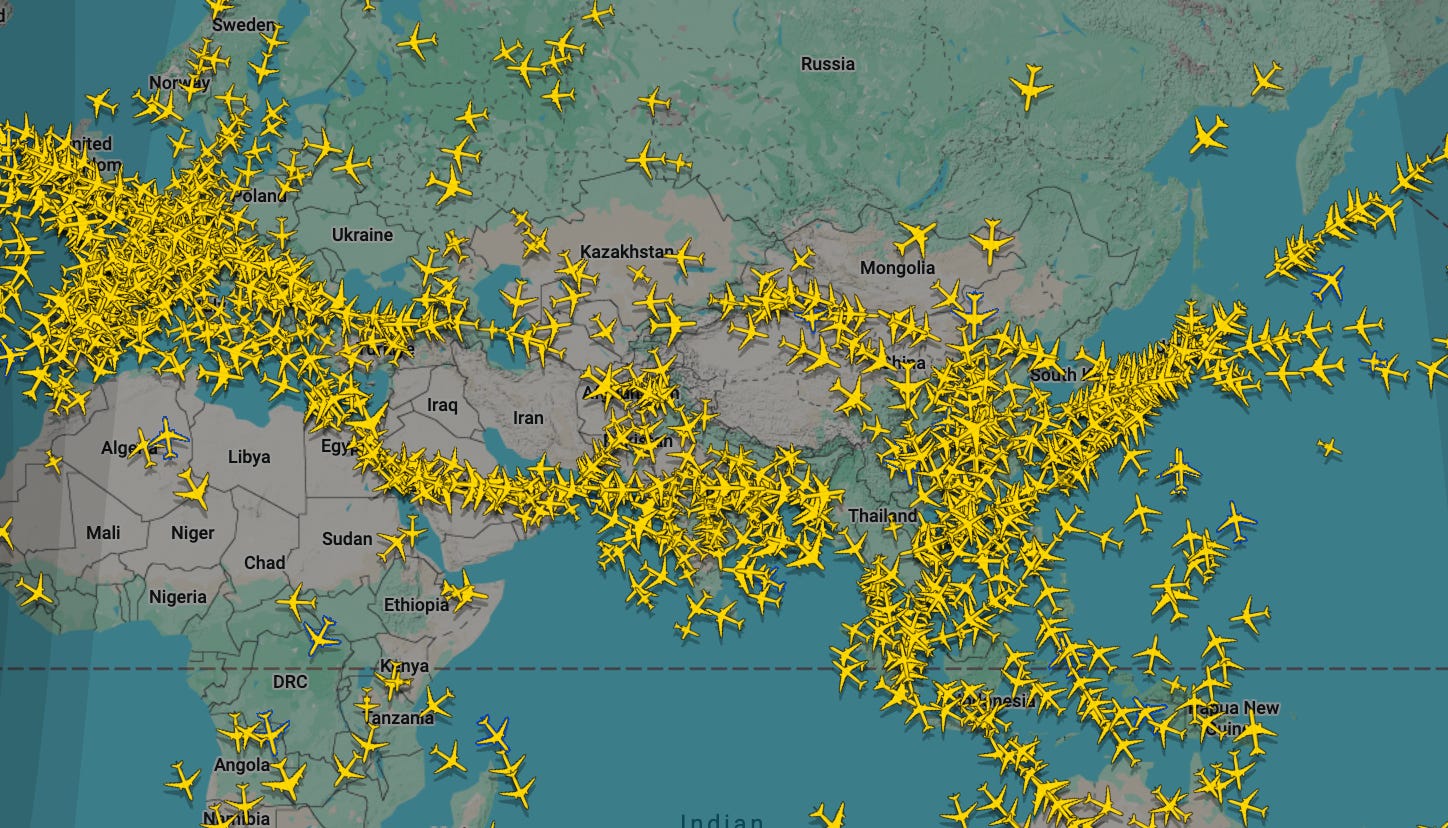
The Earth’s shape is also pretty fundamental for airlines. It’s why, on a common atlas such as the Mercator projection, flight maps often take bizarre-seeming routes. Aircraft usually fly along a great-circle route — that is, the shortest distance between two points on a sphere2. So a flight from Europe to the United States will head towards the Arctic instead of taking a ‘straight’ line over the Atlantic.
Airlines also follow particular routes for reasons unrelated to Earth’s shape. For instance, to take advantage of high-altitude winds which, even if slightly less direct, can save fuel and time. Aircraft also tend not to fly over the Himalayan mountains, due to air turbulence and limited emergency landing options. But there is an increasingly common cause of odd-looking flight maps: conflict.
Airspace closures sparked by war are becoming an increasingly common feature of global aviation. This is a subject I covered last May, when India and Pakistan closed their airspace to each other’s airlines following a terrorist attack on tourists in Kashmir, in which 26 people died, and precipitated a four-day conflict between the two countries.
A flight map is a war map

If you want to understand the state of the world, you could do worse than gazing at a map of the skies.
Fast forward to March 2025, where there is more war — and more shuttered skies.
Mind the Gulf
The airspace above the Middle East is — in normal times — some of the busiest in the world. I would enjoy little more than to discuss at length the economic and geopolitical reasons for this, but fundamentally, the Persian Gulf is simply well located between continents.
And not just Europe and Asia, but Asia and Africa too. It is why Emirates, Etihad Airways and Qatar Airways have been able to build and sustain massive hub operations in the first place. Passengers either need to change planes somewhere, or choose to because it is cheaper to fly one stop than direct.
But there’s a problem. In the wake of the US-Israeli attack on Iran, Tehran has responded not only by firing missiles and drones at American assets in the region and Israeli cities, but also at Gulf states. As a result, the skies above the region — which previously ferried roughly half a million people a day — are now largely empty.
You might think ‘so what?’ Simply fly with a non-Middle Eastern carrier such as British Airways or Singapore Airlines, which need not land in the Gulf. But such a view runs into another problem. Multiple (and hitherto) isolated airspace closures are coming remarkably close to forming a mile-high barrier in the skies.
An aluminium curtain over Eurasia
Russian airspace has been closed to Western airlines since February 2022, while Ukraine's airspace has remained fully shut to civil aviation since the same time. Now there is a sea of red across Gulf countries, Lebanon, Syria, Iraq and of course Iran. Afghanistan’s airspace remains open but has no air traffic control service. It is also subject to a conflict with Pakistan which may escalate further. Pakistan, meanwhile, is still off-limits to Indian carriers and vice versa.
Consequently, just two main corridors remain: the skies above Azerbaijan and Saudi Arabia. If they were to fully shut, it would not matter who you had booked with. You’re probably not going anywhere. I’m not exaggerating.