


Is this the government the British people thought it was electing 18 months ago? Having campaigned on economic growth as its number one priority, a Labour chancellor just delivered a Budget in which the Office for Budget Responsibility concluded that not a single measure would have a “material” impact on the UK’s long-term growth potential, and which saw GDP growth downgraded in every future year of the forecast.
Having ruled out taxes on “working people”, it hiked employers’ national insurance in its first year and froze personal tax thresholds in its second, for a total tax raid of £70bn or roughly 2% of GDP. And, having failed to withdraw Winter Fuel Payments from wealthier pensioners, it has subsequently directed a further £12bn into welfare. In short, this government is more left-wing, at least in economic terms, than it said it would be.
The party’s moves have a ring of logic. First, as The Economist’s Duncan Robinson put it in a recent column, “The tax-and-spend party has taxed and spent.” In other words, this is Labour — what did you expect? It also chimes with a piece I wrote a few weeks ago citing research by Professor Jane Green and Marta Miori for Nuffield College, which suggested that, despite its polling lead, Reform UK isn’t Labour’s principal rival. Instead, the party needs to dominate its own voting bloc, and that will require not quite so enthusiastically alienating its liberal base.

Nevertheless, Labour ditching the rhetorical centre-ground in favour of a more robust (if still slightly embarrassed) left-wing position opens up an opportunity for the traditional party of the centre-right. The question, of course, is can they take it?
“The uneatable, the unspeakable, and the unelectable”
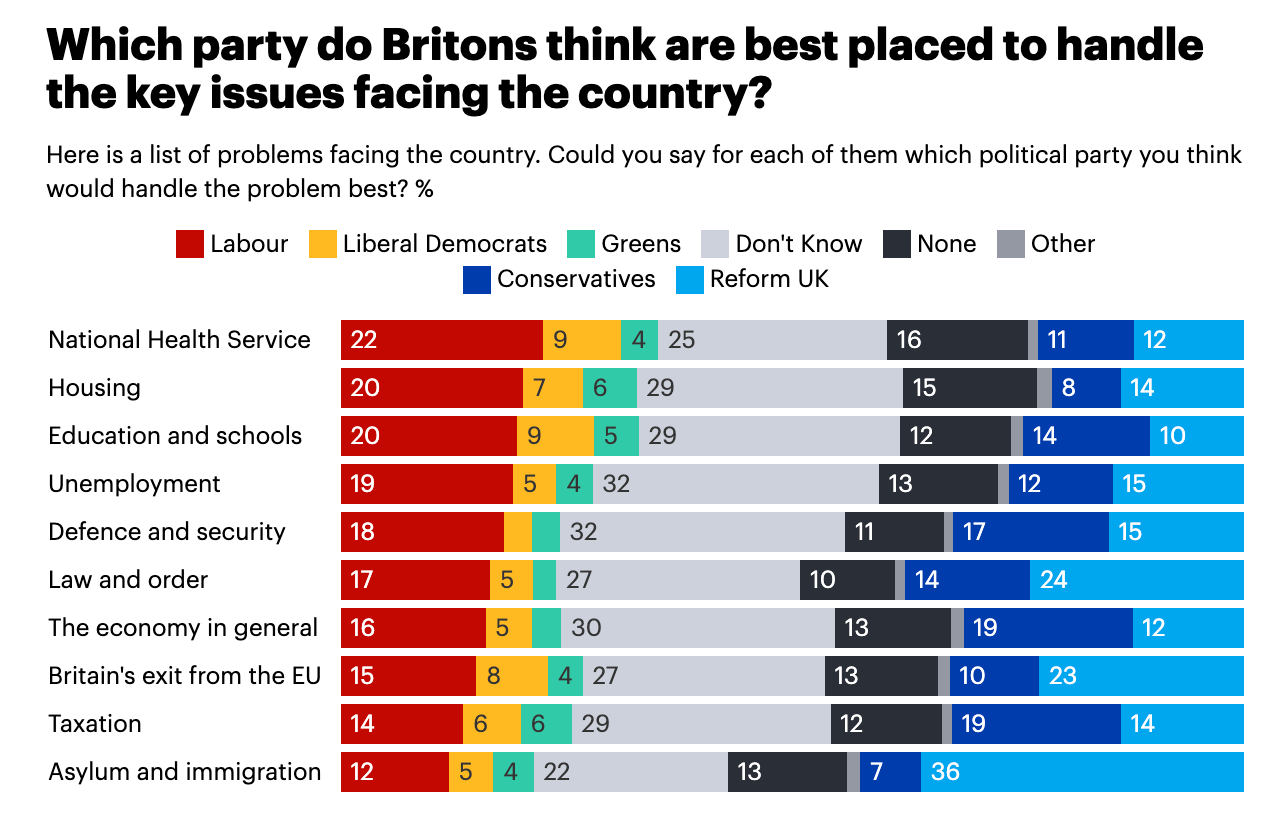
Unlike Labour, the Conservative Party does need to compete directly with Reform UK in order to lead its bloc. But the Tories also have specific strengths they can lean on, vis-à-vis Reform and Labour. According to YouGov’s various trackers, when voters are asked which party they trust most to handle a given issue, the Tories lead Labour on the economy (20% to 12%), taxation (19% to 10%), defence and security (18% to 14%) and law and order (15% to 14%).
These numbers are not exactly landslide material. But they are also not nothing for a party that a year and a half ago suffered its worst general election defeat in its near-200-year history. That voters trust them more on the economy than Labour suggests that the Liz Truss ‘mini-Budget’ may not have damaged their reputation for economic competence as badly as first imagined.
A party laser-focused on supporting the aspiration of the British people, the ambitions of entrepreneurs and in assuaging the bond markets — you know, a normie centre-right party — may no longer secure the 40-odd per cent of the vote it did in the 1980s and early 1990s, but looking at the fracturing of the UK party system, it’s not clear it needs to.
And as Labour retreats from welfare reform, goes after salary sacrifice pensions and continues to do nothing about the £100,000 childcare tax trap, in which high earners face eye-watering marginal tax rates, there is an opportunity for the Tories to champion a group of voters who really ought to be natural supporters.
But we have to ask whether the party’s leader, Kemi Badenoch, is up to it. No doubt, her performances have improved in recent weeks, and with that has come a higher level of confidence. That the Budget leaked an hour before the chancellor’s speech gave the Opposition leader a precious chance to amend her speech, rather than reply to the statement blind.
But this is also the same Badenoch who, until a few weeks ago, not only had a policy of deporting people legally living in the UK for many years, but also didn’t seem to entirely know that that was her policy. A Badenoch who has a position on Net Zero that would be unpopular with many Reform UK voters, let alone Tories and the former Tories who now vote Liberal Democrat in their droves.

Tony Blair never vacated the centre-ground, and it drove the Tories so crazy they elected Iain Duncan Smith as leader. Keir Starmer has lurched to the left almost immediately. To be fair, he has electoral incentives to do so in a way Blair never did, but it still provides a little opening for the Tories, and a chance to hoover up votes that does not involve outflanking Reform.
Still, given the party’s makeup and post-2016 trajectory, it’s hard to see how they take it.
Jack, my principal take from your graph is the proportion of “don’t knows”. In other words, many are justifiably confused about the current course of politics and the economy.
The numbers you cite, in terms of that You Gov graph, are not quite right! Eg defence & security, Labour very marginally lead the Tories! Economy: 19% to 16% Tory lead on Labour. Law & Order, graph shows Labour ahead? Conclusion, too soon for firm judgements.
Perhaps the chancellor, having given the backbench “prides” some meat to feast on, in the form of the repeal of the two children benefit cap, the latter may be more amenable when Pat McFadden makes another attempt at welfare reform? Not an original thought, but along the lines of give and take. But if the public finances stabilise, they may judge this ploy irrelevant to overall needs. (In other words, why highlight divisions?)
More broadly, in terms of party politics and personalities, the Tories now require someone of the ideological space you implicitly define. But who? I see none of the current crop who qualify, apart, perhaps, from Cleverley. Would he have another tilt? Why would he when it is extremely unlikely if not impossible for the Tories to win next time? Anyway, would the members “buy” him? (I sometimes wonder whether this exercise in mass democracy, where the members have the final say, has run its course, in terms of usefulness. Perhaps better to leave personalities to those that have a better idea.)
More broadly still, I do really think the Tories are so tainted by the 2015-2024 period that they need time, à la 1997-2010. In other words, the next Tory PM is likely now unknown to the political firmament. But does history repeat itself exactly? If they can frame themselves just to stay relevant at the next election, then your implicit suggestion that we need not expect a book along the lines of “The Strange Death of Tory England” might be correct. (Such a book actually appeared after the 2005 election. A tad premature!)
In this sense, your image of John Major is not one I would have chosen. It is a David Cameron-type figure; a currently unknown person, as I said, somewhere on the backbenches.
This was an interesting piece and dissecting it helps me!