


What was your Covid lockdown distress signal? I don’t mean the banana bread or pandemic beard, but the really chilling stuff, like unironically laughing when your colleague asks in faux confusion, “is it Tuesday or Thursday today?”. Simon from commercial has always fancied himself as a bit of a comic.
Thanks to the watchful eyes of YouTube’s search history, I can pinpoint my breakdown to mid-April 2020, when I started watching old episodes of Family Fortunes. You know, the brightly lit, distinctly suburban game show hosted by O.G. short king, Les Dennis, that became a staple of ITV’s Saturday evening lineup.
For the uninitiated: two families consisting of five members (it was always strikingly subversive when the Dad wasn’t team captain) tried to guess the most popular answers to survey questions posed to 100 people. The winning team usually went home with a bit of cash and what seemed to resemble the final car to cough and splutter its way out of a British Leyland factory.
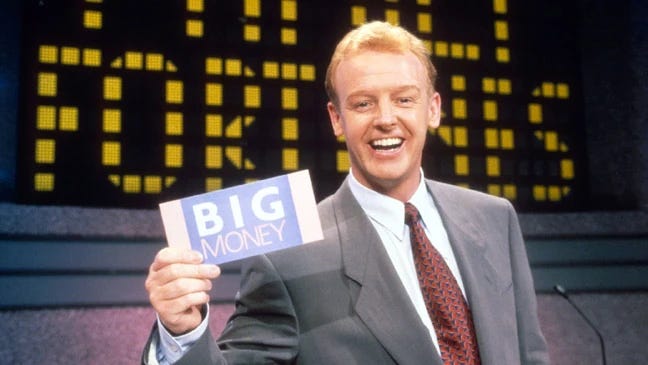
Where the more recent quiz show Pointless, presented by the double-act of Alexander Armstrong and Richard Osman, rewards contestants who skirt the boundaries of collective knowledge, Family Fortunes rewarded thinking like everyone else. Perhaps mirroring a cultural shift, from mass entertainment with its inclusive answers to a more ironic era that prizes niche facts.
Regardless, as a result of my pandemic-induced binge, by the time chancellor Rishi Sunak had defected to the virus launched Eat Out to Help Out, my finger was so firmly on the pulse of 1990s British public opinion that Tony Blair would surely have ditched Philip Gould and instead sought my guidance on New Labour’s election strategy.
Margaret Thatcher, commie basher
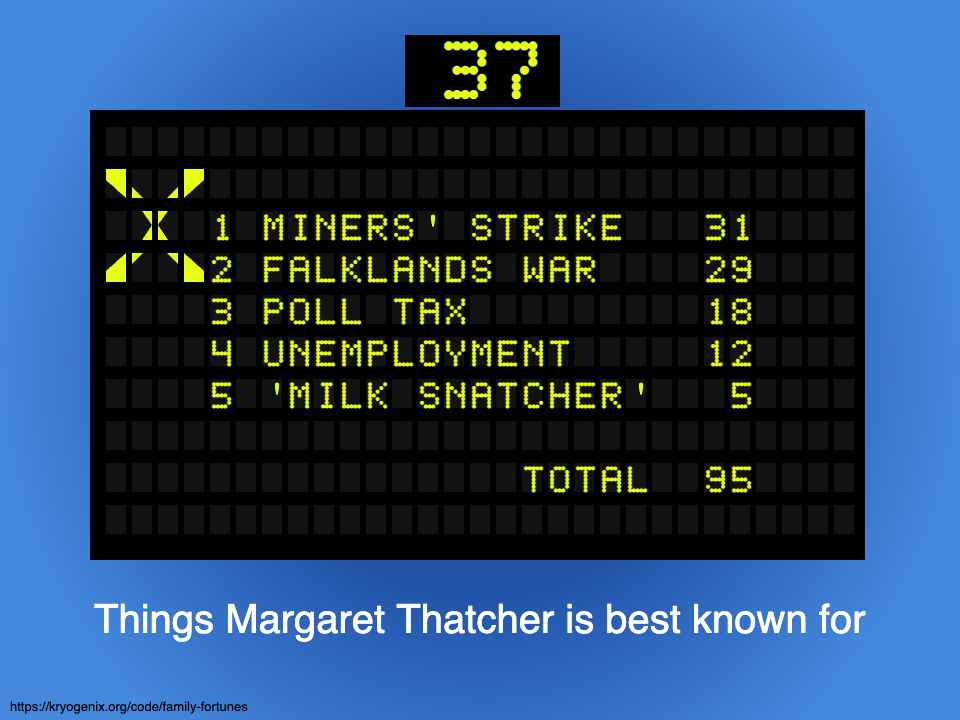
This got me thinking. If Dennis were to roll back the years to pick up a cue card that read “We asked 100 people to name what Margaret Thatcher is most famous for”, what do you think the survey would say? My guess, as articulated by this newsletter’s [imo delightfully crafted] hero image, would be:
The Miners’ Strike
The Falklands War
The Poll Tax
“No, no, no” to a federal Europe
Unemployment
“Milk-snatcher”
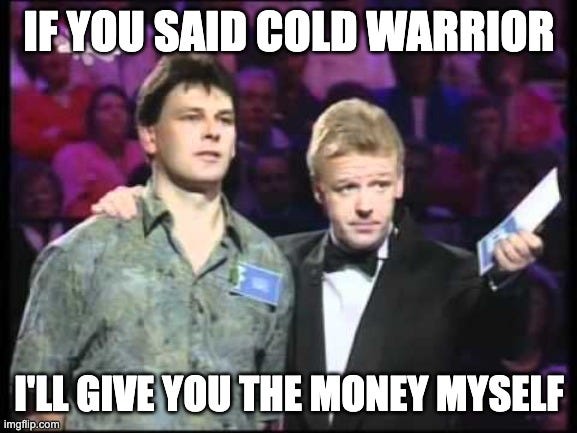
If you’d said ‘Cold Warrior’, I’m afraid you’d be going home with only £80 and a Sony camcorder. Which is strange, isn’t it? Because Thatcher became a figure of quite some foreign policy heft by the time she left office in November 1990, and had been denounced as the ‘Iron Lady’ by Krasnaya Zvezda, official newspaper of the Soviet armed forces, three years before she even came to office.
No doubt, this memory-holing is in part a consequence of Thatcher’s unique personality and, for a period, near total dominance of her government and domestic agenda. But, as Charles Moore, author of a magisterial three-volume biography of Britain’s first female prime minister has sought to demonstrate, she was an absolutely central figure on the world stage too.
Indivisible from Thatcher’s legacy is her critical, albeit necessarily supporting role, in placing greater military pressure on the Soviet Union, which in her view remained expansionist, and was only gaining strategic advantages from détente. She was steadfast in strengthening Britain’s alliances with the US and Nato, championed the hosting of American Cruise missiles, and vigorously promoted the idea of Western economic strength and the power of free-market capitalism as a bulwark against communism.
She helped bridge the gap between Ronald Reagan’s obsession with the Strategic Defence Initiative, nicknamed ‘Star Wars’, and European fears that SDI could undermine US nuclear guarantees. And, despite a highly-cultivated hard-line reputation, she was one of the first leaders to recognise the opportunity of working with Mikhail Gorbachev.1
In addition to the Cold War stuff, Thatcher was central to the West’s bullish response to Saddam Hussein’s invasion of Kuwait, and before she became a fierce critic of European integration, was successful in her push for a more market-oriented Community, ultimately helping to build what later became the EU single market.
And this wasn’t just about influence accrued by the end of her premiership. As Moore notes, once German chancellor Helmut Schmidt left office in October 1982, Thatcher became the senior leader of the West in terms of length of service, a position she held for the rest of the decade. Little wonder that everyone who was anyone in the world wanted to meet with her. Her unusualness as a woman leader made her possibly the most famous politician going.
So what?
Why am I writing about this? Well, first of all, how about you come up with 250 newsletter ideas a year? But more to the point, though I haven’t yet finished Moore’s trilogy, I have watched and listened to every interview he has given. And, after being quite taken by his range of jumpers, distracted by how remarkably alike his voice is to one of my uncles, and occasionally shocked by a stray right-wing observation, it was his point about Britain’s parochial view of Mrs Thatcher that most struck a chord with me.
Of course, this is far from a British disease2. The same gap between domestic and international reputation constantly re-appears in politics. Last week, Ukrainian President Volodymyr Zelensky drew widespread criticism and sparked mass protests by firing his Defence Minister, Mykhailo Federov. You’ll be relieved to hear I take absolutely no view on this, not least because I only learned of Federov’s name yesterday. Instead, read the update from historian and Substacker, Phillips O’Brien.
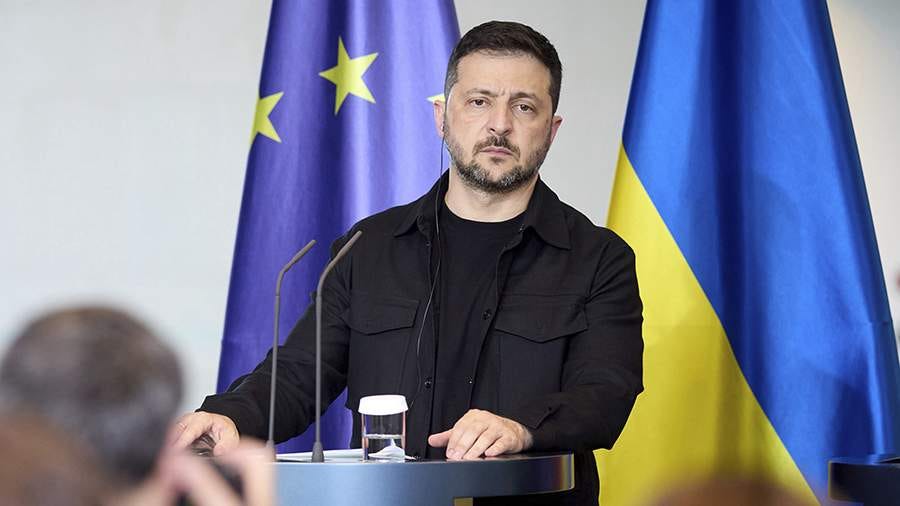
But it serves as a reminder that leaders tend to be remembered quite differently at home than abroad. In Britain, Zelensky is part legend, part Zoom therapist for under-fire prime ministers. In Ukraine, he is a symbol of national resistance and a war leader who also faces severe criticism over the centralisation of power, allegations of corruption and changes in personnel.
There are plenty of other examples too. Gorbachev himself, who is celebrated abroad for helping to end the Cold War but widely blamed in Russia for the economic turmoil and loss of great power status that wrought. More recently (and marginally less geopolitically important) there was Jacinda Ardern, admired abroad among left-wing circles but who became so divisive in New Zealand over her economic and pandemic policies that she stood down rather than face re-election.
One of life's thornier truths is that we are different people to everyone in our lives. Not just a father and son, friend and colleague, but a million others too. Hold the door open for an elderly neighbour and you might be a kindly soul; block the other’s driveway and you are pigeonholed as an enemy for life.
For that reason and more, I have absolutely no desire to learn what 100 people would say if they were asked to name what they thought about me.
Her famous remark, “I like Mr. Gorbachev. We can do business together” occurred in December 1984, before his appointment as General Secretary
And it makes sense. Change my tax rate and I notice it quicker than some important but potentially esoteric foreign policy doctrine that doesn’t matter (until it does)
You acted on a very good idea today, Jack! Your reference to Zelensky is quote interesting. I wonder whether, when the Ukraine war comes to an end and elections are held, its electorate might do to him what we did to Churchill in 1945. (Though judging from his overall, and quite understandable, weary demeanour, he may not stand for re-election. Well, unless he then becomes a….target.)