


The joke goes something like this: in the 1960s, Sweden switched from driving on the left-hand side of the road to the right. But being deeply cautious planners, the Swedes were determined to make sure it went smoothly. So they phased in the change over a period of six months, starting with heavy goods vehicles. If that proved successful, passenger cars and bicycles would follow.
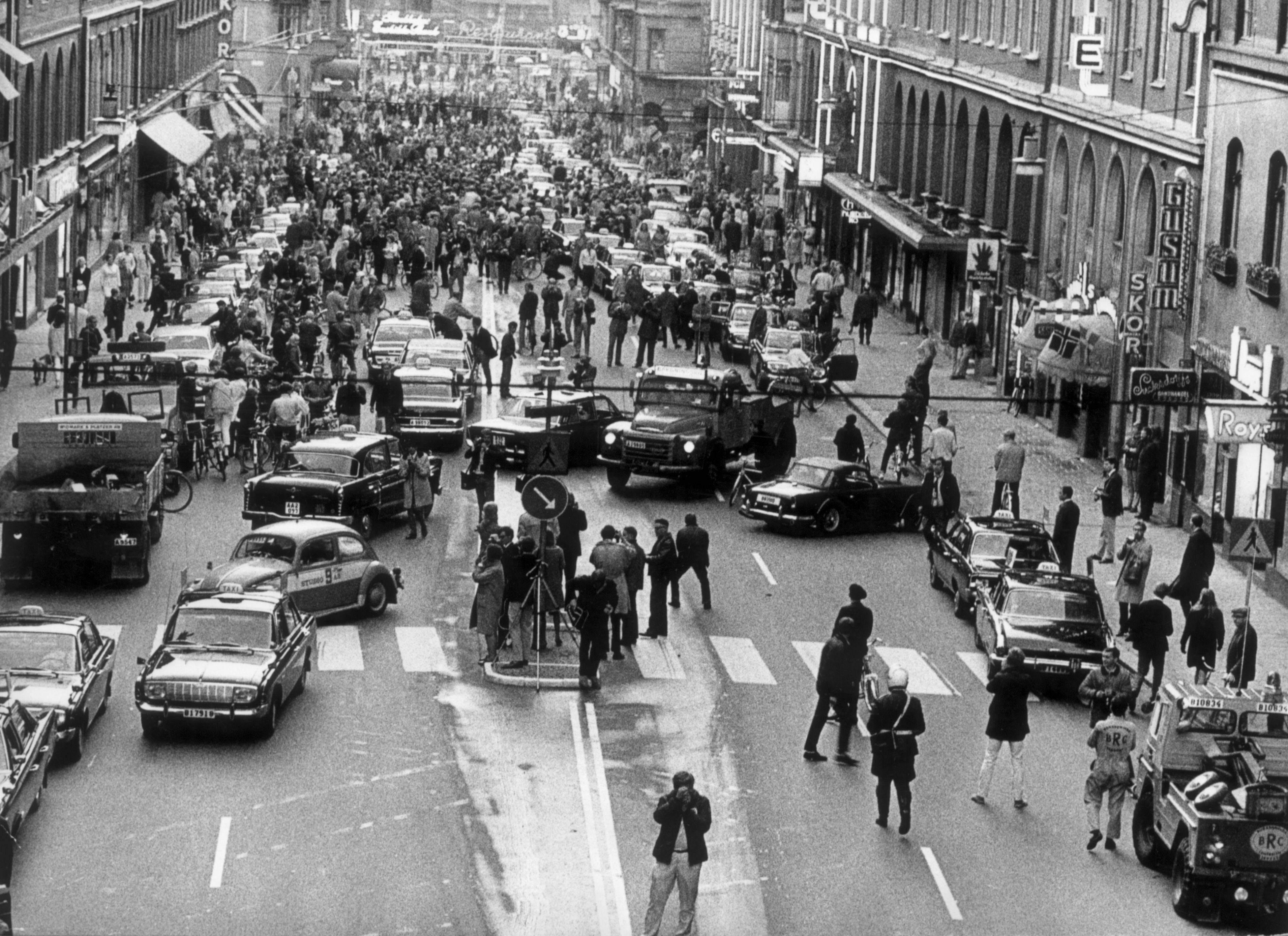
In reality the switch — known as Dagen H — took place at a specific time on a single day. On 3 September 1967, all non-essential traffic was banned between the hours of 1am and 6am. At 4:50am, any vehicles still on the road were required to come to a complete stop and move over to the other side. Ten minutes later, at 5am, it was done.
Process stories
I was thinking about this while moving house today (no need to send welcome gifts — one flat is much like another). Specifically, how strange it is to be sleeping, showering, laughing and crying in a place called home until one day, you close the door for the last time, never to return.
To be clear, I have no legal basis for complaint. I’ve ceased paying rent on the old property, got my security deposit back and have bequeathed the maddeningly unresponsive induction hob to the new tenants. Still, it’s all rather… binary. And we don’t talk about it.
I think the closest we — and I’m speaking on behalf of the nation here — got to it was during the Wars of Brexit Succession. On 23 June 2016, roughly 17.4m people voted for the United Kingdom to leave the European Union. And many of them — members of parliament included — genuinely appeared to believe that was in effect job done.
But Brexit was (and is) a process, not an event, one that Britain will be negotiating for as long as the bloc has breath in its lungs. Clearly, the unpicking of almost half a century of integration was never going to happen at 5am in a month of Sundays.
Purely as a side note, one reason why the UK secured such a thin trade deal with the EU was not simply our maximalist war aims (no freedom of movement, scope to sign our own trade deals, s o v e r e i g n t y), but also the fact that, as set out in a 2018 speech by Sir Ivan Rogers, former UK Permanent Representative to the EU:
The EU, while strategically myopic, is formidably good at process against negotiating opponents. We have to be equally so, or we will get hammered. Repeatedly.
And you’ll never guess what happened next.
False dichotomies
Of course, we encounter the process-versus-event conundrum across the piece. Ageing is a process, death an event. Marriage is a process, the wedding an event. Moving house (despite what’s inferred above) is a process, the realisation that in order to unpack the many, many boxes you need scissors — and those scissors are in one of the boxes — now that is an event.
We take this all in our stride. It would be treated as thoroughly unusual to be dead on-and-off for a period of years. Yet we consider ageing — a process by which our skin literally shrivels and gums recede — perfectly normal.
Put another way, I’m quite convinced that if rain were simply not a standard part of the hydrological cycle1, we’d find it pretty terrifying if water suddenly began falling from the sky. Like this scene from a ‘Treehouse of Horror’ episode of The Simpsons, when doughnuts dropped as rain and it’s treated as wholly unremarkable.
Perhaps this distinction — between process and event, binary and gradual — is just our brain taking shortcuts. Nature works continually, but humans like to mark moments for convenience, ritual or just obsessive record-keeping. Many instances that feel like events are really the visible peaks of continuous processes: weddings as a celebration of relationship-building, graduation the boozy denouement to an educational journey.
In which case, even Dagen H wasn’t really an event. It was the culmination of a process years in the making. The Swedish government spent hundreds of millions of kronor on infrastructure modifications and information campaigns that included television advertisements, school talks and a logo emblazoned on everything from billboards to milk cartons. 5am on 3 September 1967 was just time.
Though, could Manchester be said to exit without precipitation?
Good Morning, Jack. Considering you are going through one of life’s more challenging events (er..sorry, processes), you seem quite equable this day! Perhaps thinking in this way helps you get over the stress of the actual phase of dislocation and adaptation…and keeping this newsletter going smoothly!
[A national UK analogy to the Sweden example might be 1970s currency decimalisation. Indeed, the longer period of mental adjustment and calculation & recalc. must have made it seem, for most, more like a process.]
I suppose this distinction can be applied to how wars begin, too. And indeed, some have drawn this distinction millennia since. (No, I have not been reincarnated; or at least, I don’t think so.)
Great piece ( as always Jack) . I’ve forgotten how funny the donut clip is ! Also how incredibly difficult it was shutting the door on my family home when it was sold a few years ago. We are, of course, only lent dwellings but it housed three generations of family members during our 60 plus year tenure . Many tears,much laughter, and an abundance of music .