


Like the story of Hanukkah (oil lasting for eight days) or the history of income tax (introduced as a ‘temporary’ measure to fund war against Napoleon) I managed to spin out Charles Moore’s magisterial biography of Margaret Thatcher for almost the entirety of November.
This required the kind of discipline and efficiency of which The Lady herself would have approved. And still, thanks to the magic of audiobooks, Mrs Thatcher always seemed to be with me:
Childhood in Grantham while brushing my teeth
Search for a suitable seat while making scrambled eggs
Challenging Ted Heath while climbing the stairs
Junking monetarism while searching for my keys
Losing her “unassailable”1 chancellor while misjudging the gap between pavement and bus.
By the time I went to bed, it seemed inconceivable that a man could be prime minister.
The iron rule
The surest way to ruin a book is to read it with the intent of writing a review. One ends up stopping and starting, scribbling copious notes and pretty soon the thing takes on the air of GCSE coursework. Instead, I took a screenshot every time a story caught my ear or a thought came to mind, on the understanding that I would return to it (and the hope that, when I did, I might remember why).
As for the bookmarks, I counted them all out and I counted them all back2 and we’re looking at roughly 175. So, at least I know what I’ll be doing this weekend. For today, I wanted only to highlight the most striking choices Thatcher made. Not the easy things, the good versus bad as she saw it: free markets or socialism, West or East. But those dilemmas where the choice is between good and good or bad and bad.
That is when we learn what people in power really believe.
Choice 1: ERM vs political survival
It is not post-Black Wednesday revisionism to state that Thatcher was opposed to Britain’s membership of the European Exchange Rate Mechanism. She believed membership entailed:
Loss of monetary sovereignty — Interest rates would increasingly be dictated by the need to maintain sterling’s position within a given band, rather than domestic inflation.
German dominance — In practice, the Bundesbank’s decisions would heavily influence European monetary policy.3
Inflexibility — She believed exchange rates should be allowed to adjust to economic circumstances, rather than governments artificially maintaining them at politically agreed levels.
The single currency — She feared ERM as a gateway drug to the euro.
So why did she finally agree to join, not least when Britain hadn’t even met the self-imposed Madrid conditions?4 Having already lost a chancellor and moved a foreign secretary, in part over the issue (only to replace them with two men who also supported ERM membership), she had run out of political road.
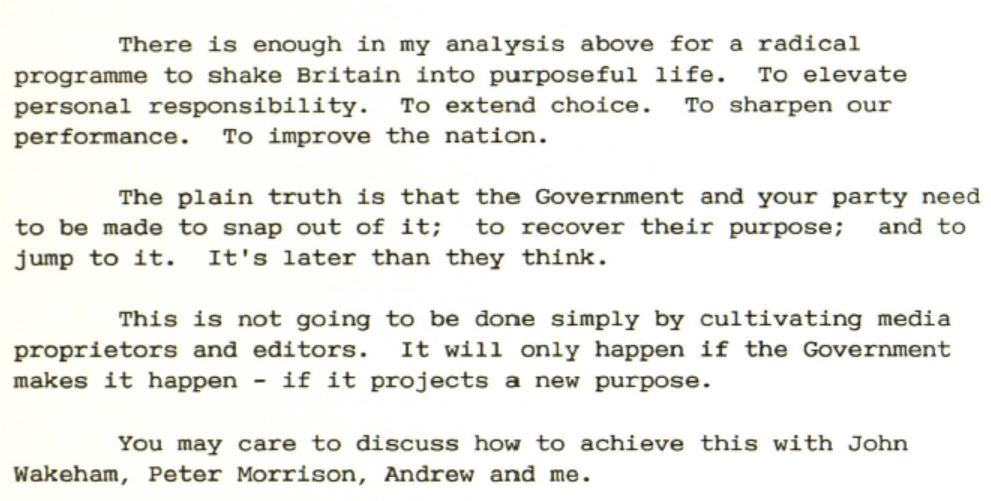
As her private papers show, such was the prime minister’s isolation by 1990 that she essentially had no choice in the matter, so joining the ERM became part of her “fightback” strategy and a way to discomfort a resurgent Labour Party.
Ultimately, she wanted to keep being prime minister more than she wanted to stay out of the ERM, and concluded any likely successor would join anyway.
Choice 2: Germany vs the Cold War
Thatcher did not like Germans or Germany. This explains why the ultimate Cold Warrior, the woman who detested détente and railed against the 1975 Helsinki Accords, who alongside Ronald Reagan wanted to win the Cold War, was horrified by the natural consequences of victory: a united Germany at the heart of a federal Europe.
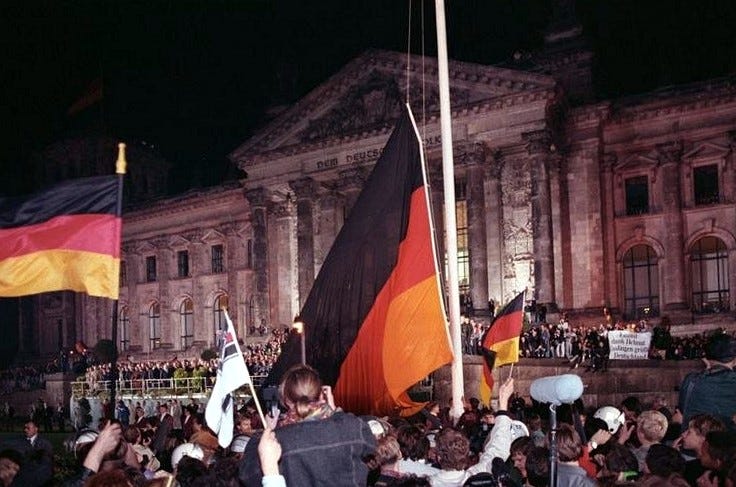
In the end, she was powerless to prevent it, thanks to the political skills of Helmut Kohl, the enthusiasm of George H. W. Bush and the realpolitik of François Mitterrand,5 who didn’t much fancy German unification either but figured it was unavoidable and so the French might as well secure some benefits, in their case a German commitment to monetary union.
Choice 3: Human rights vs Falklands allies
Why the heck did Thatcher so full-throatedly take the side of General Augusto Pinochet, under whom the people of Chile were subjected to a systematic campaign of torture and state violence, with the Rettig Commission reaching conclusions of about 2,279 cases of political execution and disappearance during the period of military rule from 1973 to 1990? This woman who was so admirably clear on her support for human rights in Eastern Europe and beyond?
Simply put, she found it difficult to abandon anyone who assisted Britain, and saved the lives of British servicemen and women during the Falklands War. Chile had gone so far as to install military radar in sight of an Argentinian military airbase, giving real-time information on enemy aircraft movements and this created a strong sense of personal indebtedness.