


Mr Speaker: Questions to the prime minister! I call the Labour MP for Good Grief My Majority Is Less Than The Lib Dem, Green and Independent Vote Combined Central.
Labour MP: Will the prime minister join me in expressing some economic populism I don’t really share because I’ve run a sensible think tank but I can repackage for short-form video content, and agree that we should be protecting welfare, not cutting taxes for millionaires?
Prime Minister: My hon friend is correct and this government is etc and so on…
The pyramid of doom
The leaves are turning brown, the transfer window has shut1 and the Labour government is facing a tight budget: autumn is coming. And everywhere the chancellor looks, the data appears to disappoint. At the risk of engaging in some cringe-inducing parliamentary call-and-response:
Gilt yields: up! Growth forecasts: down! Inflation: sticky! Fiscal headroom: halved! Defence Investment Plan: unfunded! Strait of Hormuz: closed!
And that’s before we get to the long-run. A recent paper by Ben Ansell, professor of politics at Oxford University, for the Institute for Public Policy Research, sets out the sheer scale of the fiscal pressures Britain faces this century, largely as a result of an ageing population, as well as higher spending on defence and the transition to net zero.
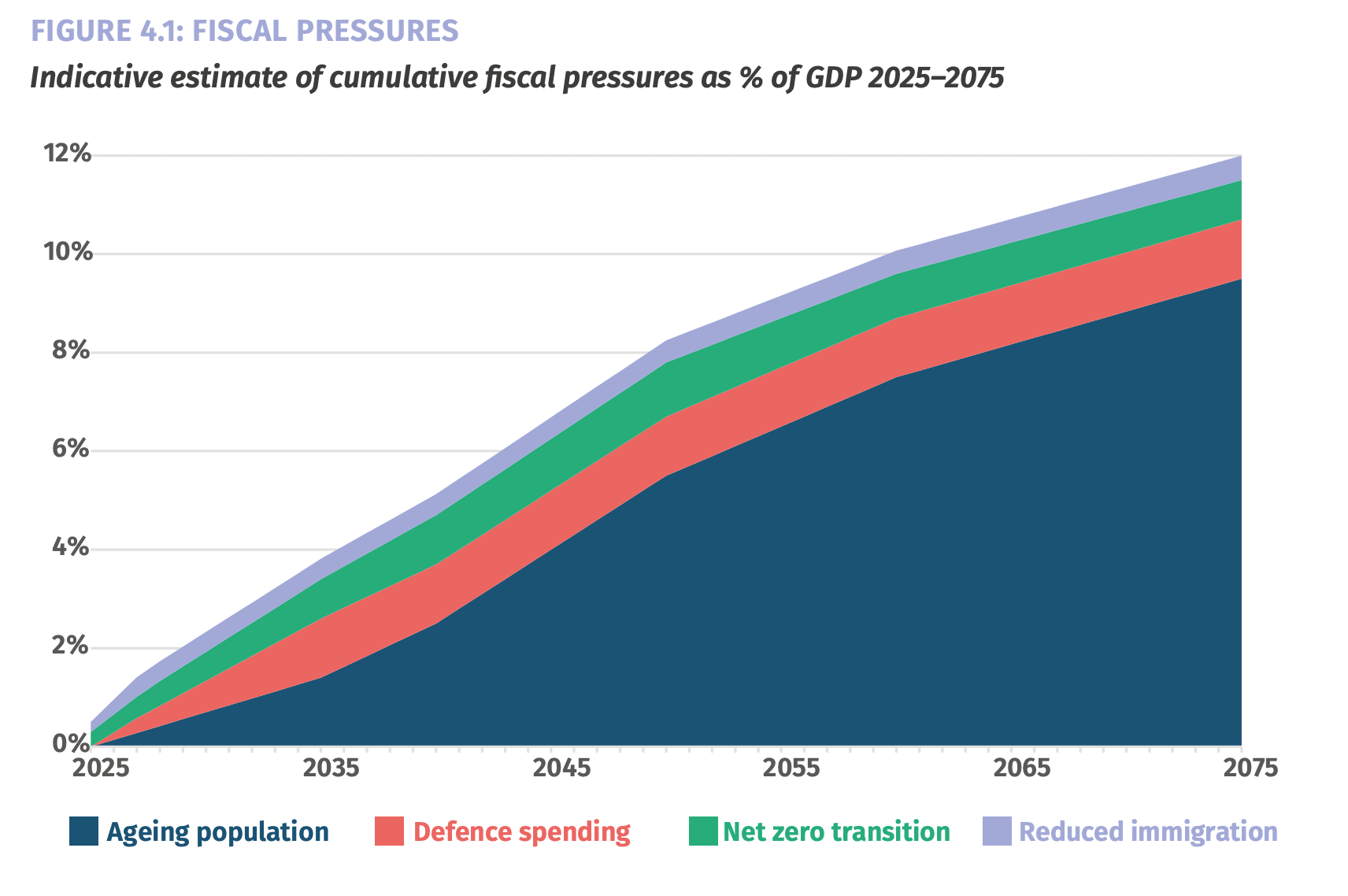
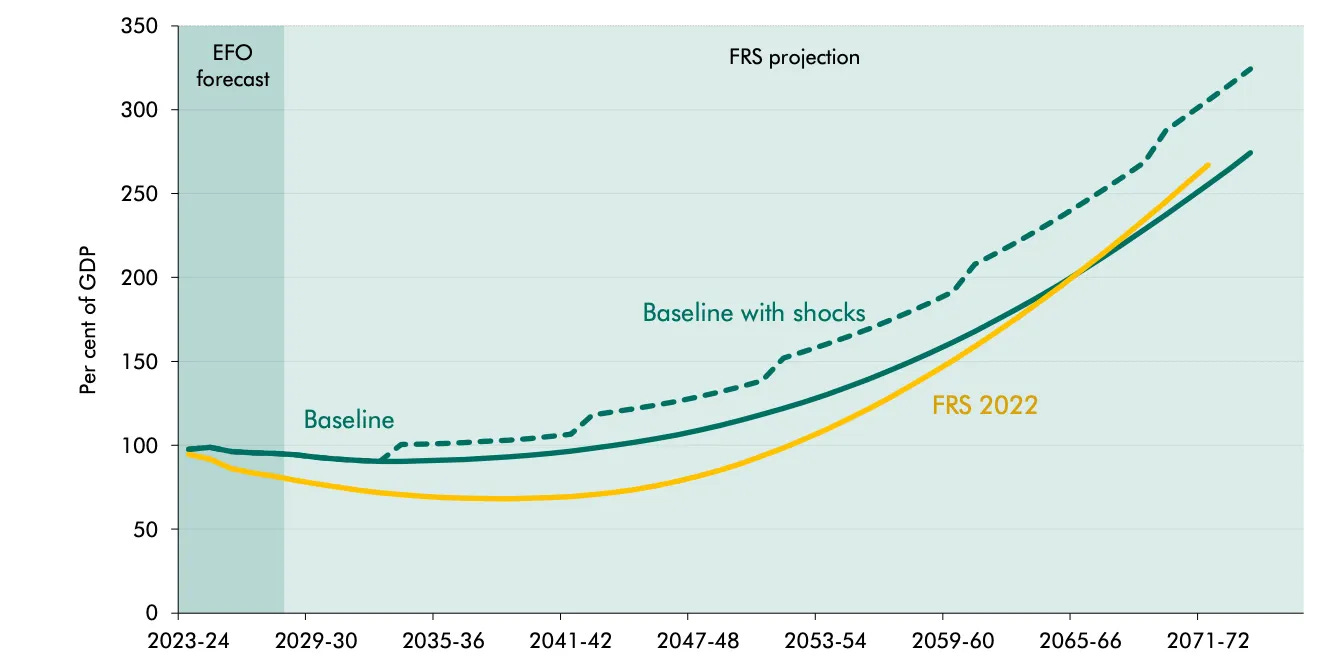
This delightfully chimes with what, in my Treasury days (or, as the South Koreans would call it, my Leeds Days2), we referred to the graph of doom. Essentially, for many of the same reasons, UK debt spirals to roughly 275% of GDP by 2075.
Now, despite the best efforts of successive governments and the British people in the odd plebiscite, the UK economy remains large and contains multitudes. Consequently, super long-term projections such as these are about as accurate as my personal bête noire, monthly GDP figures.
Nevertheless, the direction of travel on spending is pretty clear. As, indeed, is the tax burden.
Middle earners, low taxpayers
The overall tax burden is at record levels3, driven by effective rates on high earners and corporate profits. Simply put, those with the “broadest shoulders” are carrying more of the weight. For instance, income tax paid by the top 10% of income tax payers rose from 53.5% in 2010-11 to 60.3% in 2023-24, according to the Institute for Fiscal Studies.
At the same time, middle earners or, to use the nomenclature, “working people”, have seen their income tax and National Insurance contributions fall since 2010. Indeed, at the point of the last election, the effective personal tax rate for the median earner with no children fell to its lowest point since 1975.
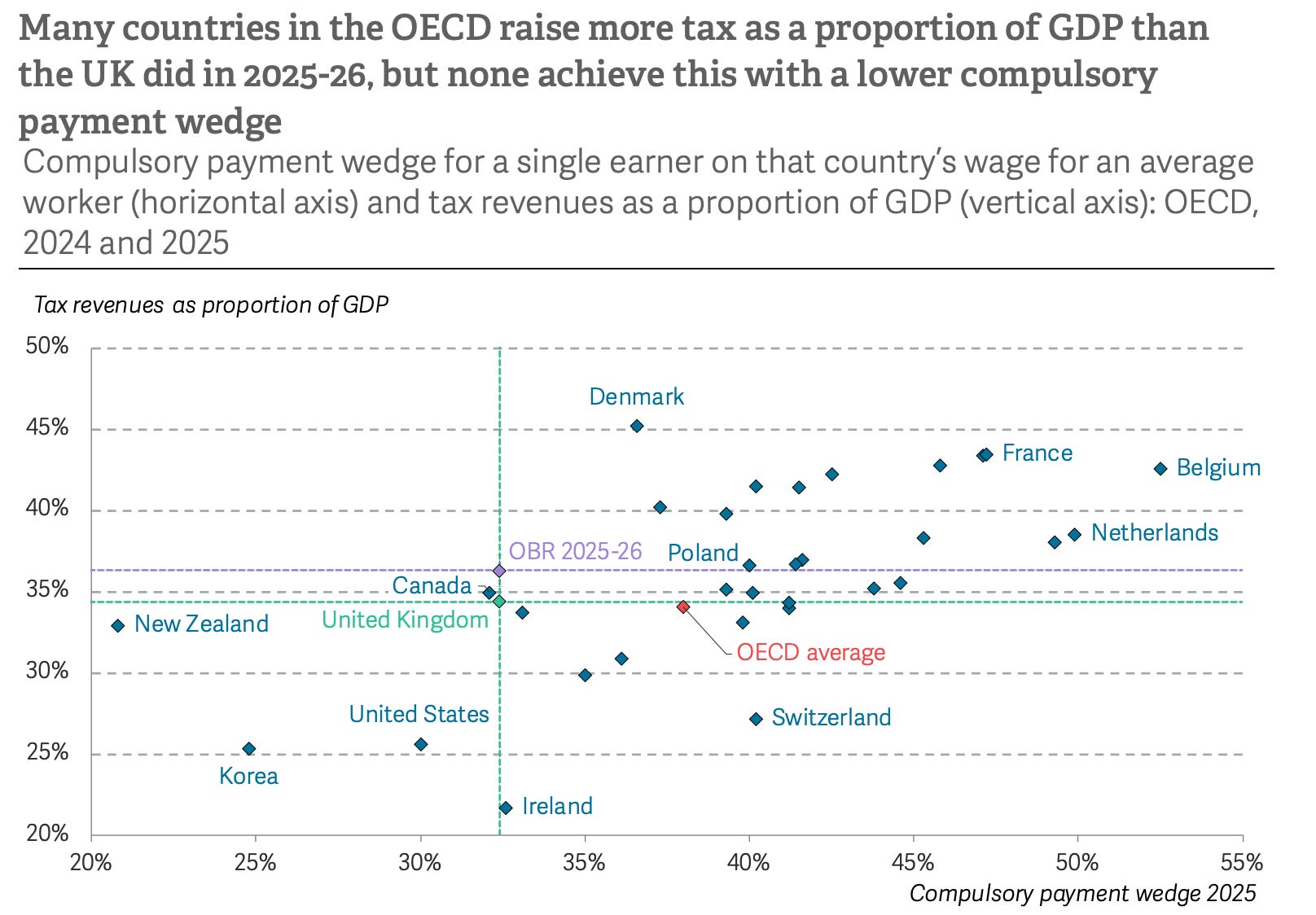
And while, as a new paper from the Resolution Foundation points out, frozen income tax thresholds have contributed to the UK seeing the largest rise in taxation on average workers across 33 comparable OECD countries, this was from “a very low base”. As a result, Britain remains in the bottom third of countries for the level of tax on the average worker and lower than before the financial crisis. The killer quote:
No country raises more in total tax as a proportion of GDP without also asking more of single average earners.
Politics aside, the era of eschewing broad-based taxes in favour of desperately plugging leaks in the ship of state by raising lots of little taxes on random bits of wealth may be coming to an end.
Now, the politics
Thank you, Captain Obvious. All the prime minister has to do is raise taxes on his own voters (the young and middle-aged, graduates and urban professionals, public sector workers etc) having inherited a manifesto commitment explicitly ruling out such a thing. Oh, and his entire schtick is protecting said voters from the cost of living. Fair challenge, but a few things:
If the best time to raise broad-based taxes was autumn 2024 and the second best 2025, now is still third best. Raising income tax would be painful, but it would not only help to fund various bits of the state and a hybrid war against Russia, it would also represent a powerful sign to the bond markets that this government was serious about fiscal responsibility, something that may also lead to yields falling.
Of course, none of this precludes extracting more money from the better off. You can do both! This was the principal error behind the High Value Council Tax Surcharge on properties valued at more than £2m (aka the mansion tax), a measure that the Office for Budget Responsibility expects will raise a pitiful £400m a year by 2029-30. Instead, the policy should have been used as a lefty shield while simultaneously raising taxes on middle earners. It’s called politics.
Believe it or not, this is a good news newsletter, albeit not a very Friday one. The money is there. But it will require someone actually willing to:
1. spend political capital and
2. make the argument
A habit Britain’s politicians have rather lost.
“Slammed” shut, to be precise
Up by around £70bn just since the last election
Your programme entails a break in manifesto promises. The electorate do not perceive that their tax burden is as benign as the facts suggests. It’s called electoral perception.
How do we get around this without a general election? I don’t see any politician, even AB, going on the telly, à la 1970s ministerials I’ve read about, and biting the bullet, telling it frankly as it is.