


I was a hopeless civil servant. In retrospect, I really ought to have taken the hint when my initial application to join the Treasury was rejected, and I was only invited to interview on the rather dubious basis that more space had opened up at a central London assessment centre. So, I went along with low expectations and was rewarded with a ludicrous slice of good luck.
The random policy area I was asked to opine on turned out to be renewable energy. Given that I had spent the previous several years working for a shadow minister with responsibility for low-carbon energy, this was not particularly arduous. By the time I casually referred to the attractiveness of renewables for institutional investors, I had the interviewers eating out of my hand.
My first role at the Treasury (or HMT to the cool kids) was working on Northern Ireland devolution, where I quickly learned that the game was to promise money to the various warring factions but in such a way that they could never actually spend it1. In a triumph of mediocrity and having brought neither political2 nor fiscal stability to Ulster, I was moved on to the Transport Tax team, with responsibility for fuel duty.
I wrote a piece last month about pointless jobs, in particular my first in Parliament, where I was tasked with tracking the attendance of MPs in the Commons chamber. In comparison, my time covering fuel duty makes that job look like air traffic control or A&E dispatch.

“Stop! Hammer time… Freeze!”
One fairly immediate consequence of the Iran War/Third Gulf War/Special Military Operation is that the price of Brent crude has skyrocketed, from roughly $65 per barrel to over $100. And while it takes time for that to be reflected in certain goods and services, it is seen almost immediately at service station forecourts. Unsurprisingly, rising pump prices have swiftly attracted political commentary.
No lesser authority — and scourge of the fossil fuel industry — Ed Miliband has joined a chorus of ministers in keeping the door open to a fuel duty freeze. The Energy Secretary told the BBC’s Laura Kuenssberg that with five months to go until September’s planned 5p per litre rise, “we’ll have to see where we are”, adding that the government would “stand by the British people in this crisis and we will do what it takes to do that.”
About that 5p rise and the history of fuel duty freezes3. I’ll try to keep this brief, both for your benefit and because the whole subject is incredibly triggering for me (in that writing about it reminds me of my twenties). Fasten your seatbelts:
1999 — the Labour government suspends the fuel duty escalator
2009 — the Labour government proposes re-introducing the escalator
2010 — the Coalition government reverses the decision
2011 — the Coalition government cuts fuel duty by 1p a litre
2012-2021 — fuel duty is frozen
2022 — a ‘temporary’ 5p cut is introduced at the Spring Statement in response to rising global oil prices
2023 — the planned inflation-linked rise is cancelled, the ‘temporary’ 5p cut is extended for a further 12 months
2024 — same again
2025 — same again
It gets sillier. Because fuel duty is supposed to be uprated by RPI inflation, and the Office for Budget Responsibility is compelled to run the numbers on that basis4, a fuel duty freeze — let alone a cut — confers a significant fiscal cost. I mean, just look at this graphic. Charlie Brown learns quicker.
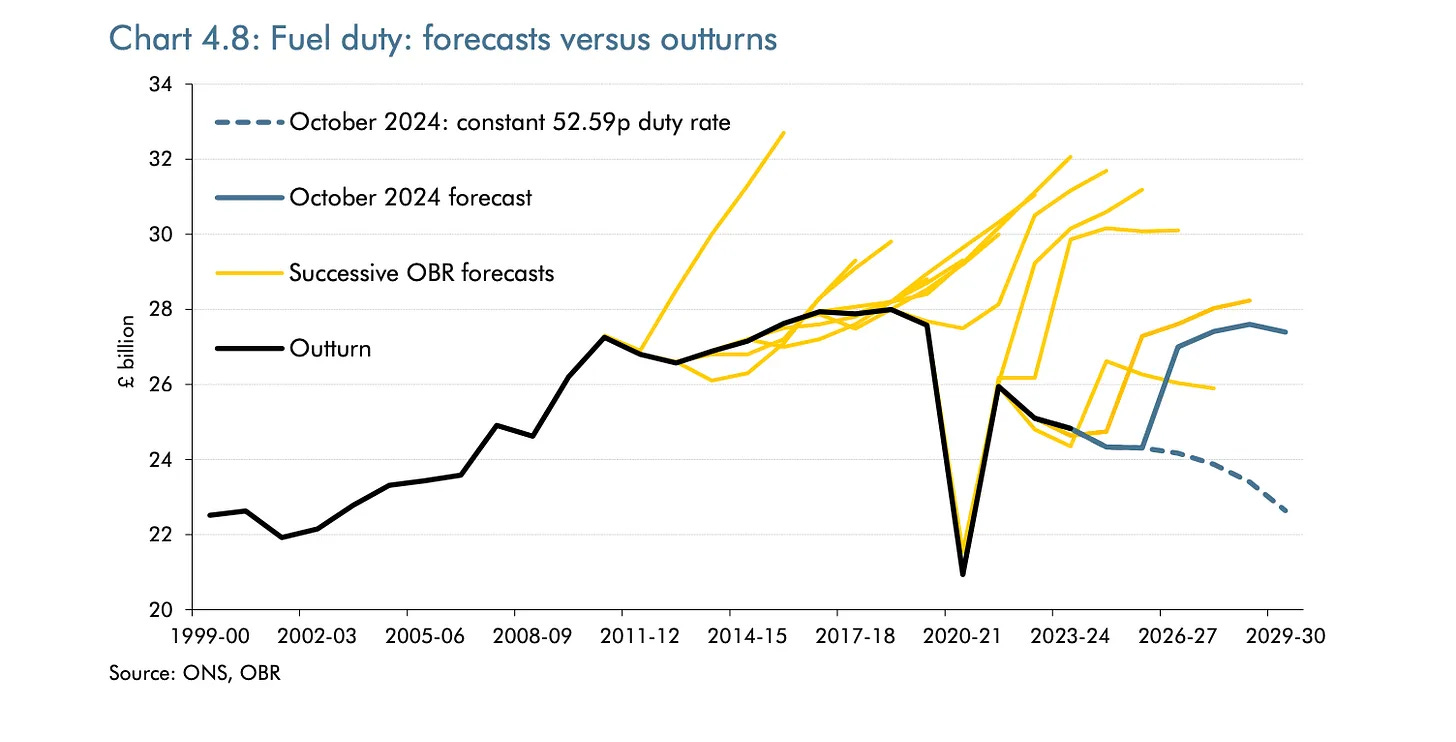
Indeed, the total bill for fuel duty freezes from 2010-11 to 2026-27 has risen to £120 billion5. Which would be useful money to have kicking around even if you weren’t approaching a debt-to-GDP ratio of 100% just when the post-Cold-War peace dividend was coming to an end.
The truly dispiriting part
The thing is, chancellors of all persuasions have for years been desperate to repair the link between fuel duty and inflation. To that extent, a little dance has developed. Special advisors brief journalists — off the record — that ministers are serious this time. Following a political steer, civil servants might draft parliamentary questions for friendly backbenchers to table, for the sole purpose of getting the high cost of further freezes into the public domain.
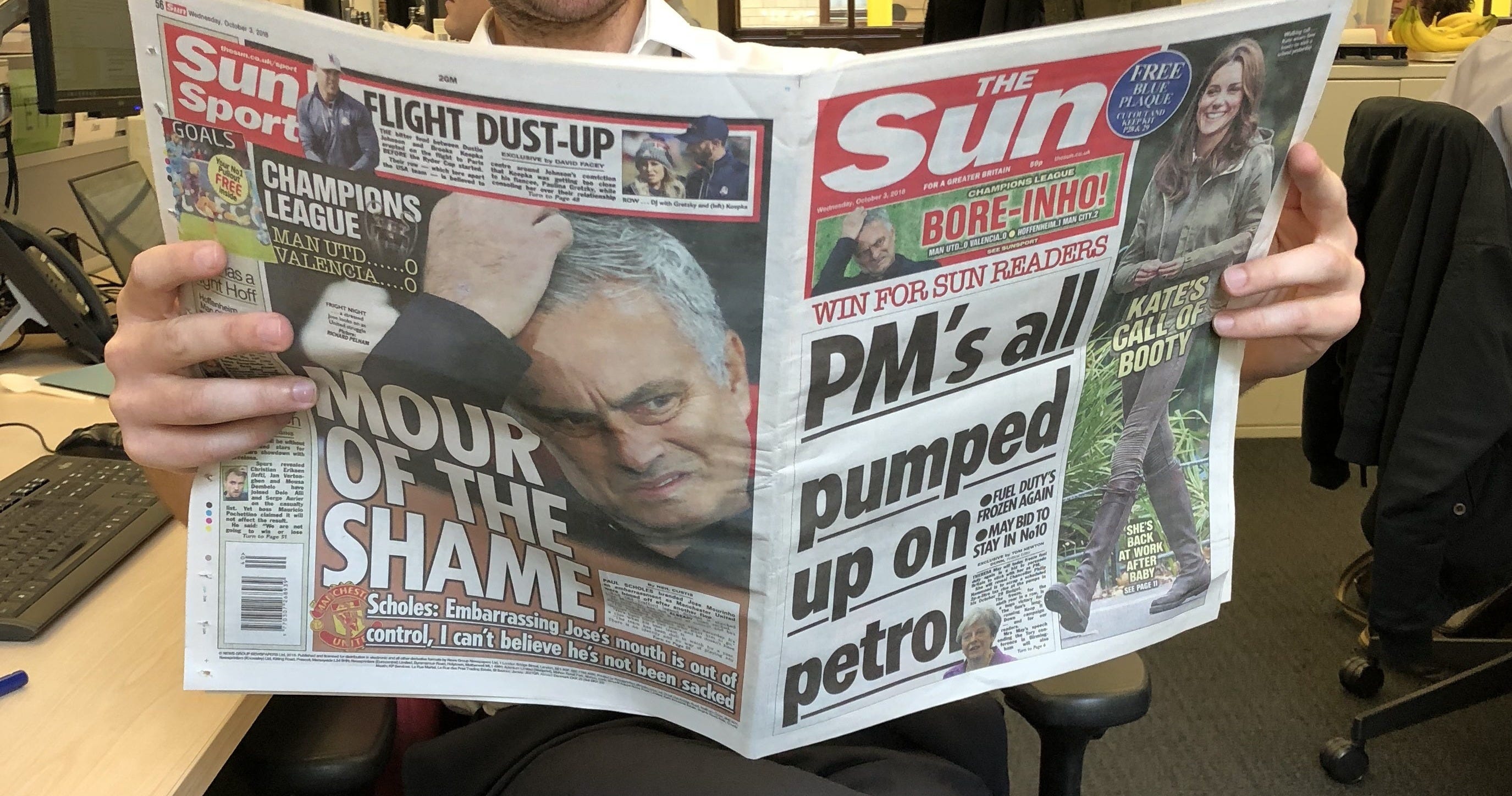
But then, political gravity reasserts itself. Unhappy government MPs sign letters pleading for leniency. The Sun re-ups its long-running ‘Keep It Down’ campaign demanding a further freeze for “cash-strapped drivers”. And Donald Trump decides to go for regime change in Iran from the sky. Still, what happens next is fairly soul-destroying from a junior Treasury official’s perspective.
Because the government’s media strategy switches on a dime, from warning about the ruinous costs of a further fuel duty freeze to waxing lyrical about how much a freeze will save drivers. Every imaginable figure is provided: savings per litre, per tank, since the previous year and so on. The subsequent briefing note puts Andy Zaltzman, BBC Test Match Special statistician, to shame.
And sure, we all get why. If the government is going to spend literally billions of pounds subsidising drivers, it may as well be able to claim the credit. But it is rather like Friday afternoon Jack screwing over Monday morning Jack by leaving a tonne of papers to return to.
TL;DR — There are only two certainties in life: death, and the Treasury retreating from raising fuel duty6.
Essentially, the wheeze is to allocate the vast majority of funds either to capital rather than current budgets, or in areas which require cross-community agreement.
The Northern Ireland Executive collapsed in early 2017 after deputy first minister Martin McGuinness resigned in protest over the Renewable Heat Incentive scandal, better known (regrettably) as ‘Cash for Ash’.
If the government had increased fuel duty by inflation since 2011, it would have stood at between 103p and 104p per litre in April 2025, instead of its current value of 52.95p per litre, according to the House of Commons Library.
Last year, the OBR highlighted that the routine process of cancelling planned fuel duty rises has created a “significant risk to the forecast.”
There is a reason David Cameron referred to Robert Halfon, who ran numerous campaigns on the issue, as the “most expensive MP in parliament”.
Sorry today’s piece was so long. I just have so few areas of genuine expertise.
Jack, this was a challenging piece, but your note 3 enabled some perspective. I think there is a structural problem with the taxation base in this country, for obvious historical reasons. Example: how many countries place such reliance on fuel and alcohol duty? Perhaps politicians have realised this, and their response is decade-long “freezes.” Think tanks may reflect on such matters, though I’ve never heard such. But elsewhere?
It's triggering for so many reasons. So at the current rate it's still at least a 1/3rd of the pump price of unleaded petrol. AND there's the VAT as well...