


Honestly, I thought it was a northern thing, like saying “me mam” instead of “my mum” or eating black pudding instead of something marginally less dense than the singularity of a black hole. One after another, Labour MPs representing long-abolished seats with names like Sheffield Hillsborough and Tyne Bridge rose from the green benches1 to ask the prime minister when she would abolish what history would later call “THE poll tax” but was, at the time, often simply “poll tax”.
What is jarring to contemporary ears makes a certain amount of sense. We don’t speak of “the income tax” or “the fuel duty”. In the English language, only specific, unique or widely understood phenomena get to dance with the definite article. The sky, the Alps, the BBC. Only once it became a defined political event and cautionary tale did it fully become “the” poll tax.
Before we go any further, I think it’s worthwhile briefly explaining what poll tax/the poll tax actually was. Because, however strange it may have been that reform to local government taxation brought down a prime minister, it was even weirder as a tax. I promise to be brief because, let’s face it, local authority funding, like sewage systems and pension contributions, is the apotheosis of ‘boring but important’.
No such thing as community [charge]
Prior to 19902, local government was funded through a system of domestic rates. Households paid tax based on the estimated rental value of their property. In theory, this was a bog-standard progressive tax: the more valuable the home, the steeper the bill. In practice, things were a lot messier.
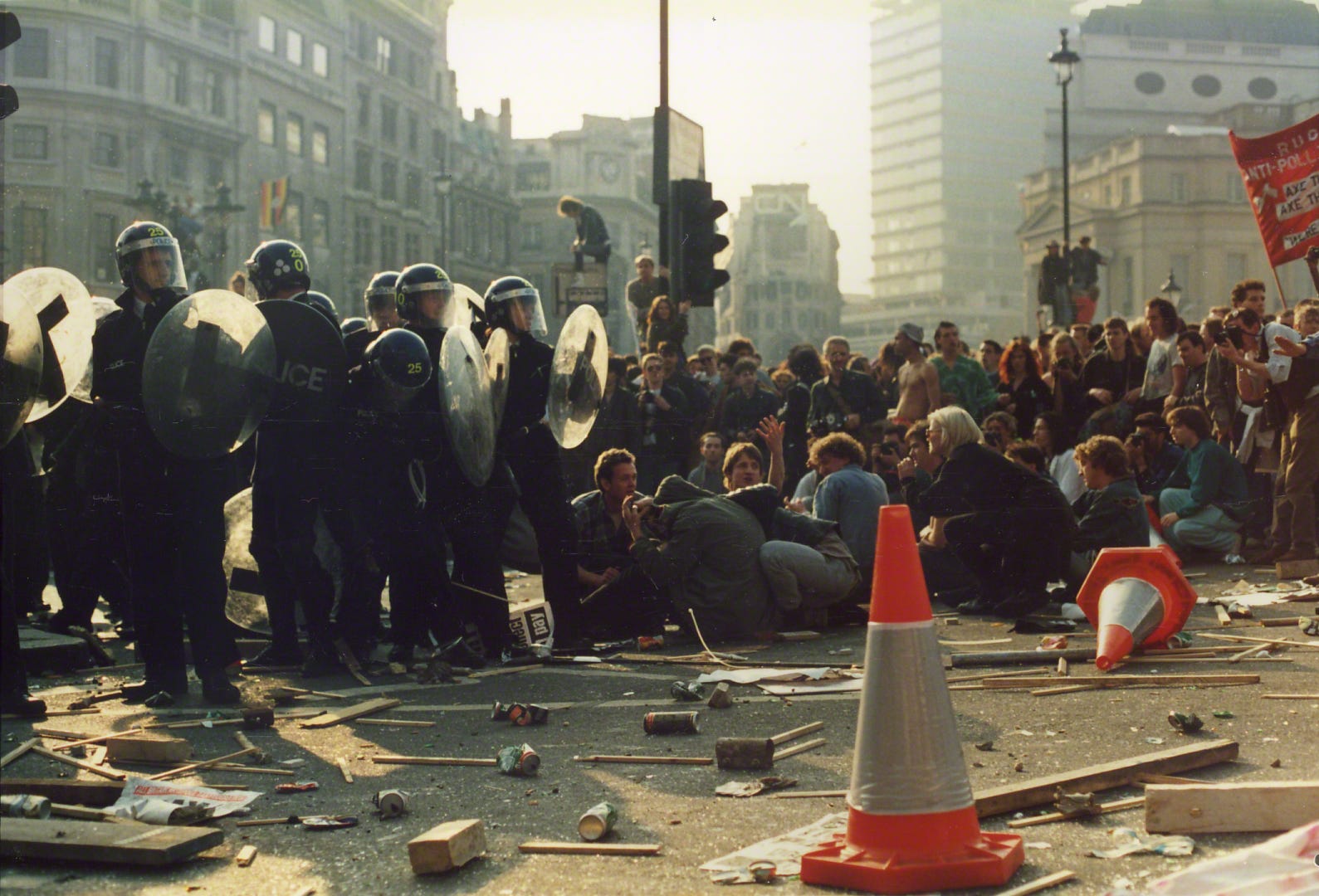
The rates were widely criticised for being outdated and opaque. Because (and stop me if you’ve heard this before) property values often hadn’t been reassessed for years, and many people didn’t know how their ‘rateable value’ was even calculated. And you’ll never guess who hated the status quo most.
Margaret Thatcher opposed the rates for a combination of ideological, practical and political reasons. She saw it as a system unfairly tied to property rather than individuals, insufficiently transparent and devoid of personal responsibility. Just as importantly, it insulated local authorities — I’m sorry, “big spending Labour councils” — from accountability to local taxpayers. In short, it was seen as something that hurt “her people”.
The solution was devilishly simple: replace the property-based tax with a per-person charge. A community charge, if you will. One that meant that every eligible adult paid a fixed amount, regardless of income. Oh, and the charge itself was to be set by local authorities, not national government. Again, the theory was sound. If your council spends more, you pay more. But the politics were toxic — devolve the tax, centralise the political pain.
So, why did she do it? Well, that depends on who you ask.
Mad, bad and dangerous to serve
The view of many of the prime minister’s critics — and I’m referring mainly to former members of her cabinet — is that she lost her touch. Her foreign secretary Douglas Hurd attributed it to Thatcher fatigue:
People ran out of patience really, out of support with her particular style of doing things.
Hurd wasn’t specifically referring to the time in early 1989, when Thatcher rushed out of Number 10 wearing a huge pink coat with bat-like fur trim, to make possibly the maddest (and campest) prime ministerial statement of all time:
“We have become a grandmother. Of a grandson, called Michael.”
Her former chancellor, Nigel Lawson, put it down to declining judgement.
Her courage didn’t desert her but her political instincts did. She became reckless3.
Thatcher was not always one to treat even her allies well. Having spent more than a decade shooting verbal bullets at her longest-serving cabinet colleague, Geoffrey Howe, she promptly demoted him before agreeing to join the European Exchange Rate Mechanism without even telling him, the nominal deputy prime minister. Howe later revealed:
I heard about it from The Queen, rather embarrassingly.
Which, let’s face it, is a bit of a humblebrag.
That the prime minister refused to U-turn on the policy despite plunging political ratings, agitated backbench MPs and a rebuke at the 1990 local elections, may come as no surprise. The lady was not for you-know-what and so on and so forth. But Thatcher’s reputation as a conviction-only politician is somewhat mythologised. Indeed, in the gleeful words of Ken Clarke:
She didn’t have an ideological agenda in 1975. I don’t think she did for most of the time she was prime minister. I think she became a Thatcherite in… about 1987, 1988 when people persuaded her there was something called Thatcherism to which she was the leader.
Without doubt, Thatcher was rather more politically agile and electoral attuned in her earlier, more fraught days in office. Which is where we pick things up tomorrow in a special, poll tax double bill.
Yes, I’ve been watching pre-fall of USSR editions of PMQs on C-SPAN again
Famously, 1989 in Scotland
Thatcher effectively chose her economic advisor, Alan Walters, over her chancellor, leading to Lawson’s resignation in October 1989 (and, ultimately, John Major as her successor).
A mad policy driven by a increasingly unhinged leader whose cabinet just ran with it.
Within the sanity context:
“Those whom the gods wish to destroy, they first drive mad.” I think this predates Virgil or Horace, but I’m sure you’ll correct me.
(Another “mad” person is thought to have opined:
“Horace tries to be Virgil but can’t do it.
Virgil tries to be Homer and can’t manage it.
Homer is far too overrated.”)
Of course, the dating distinction of 1989/1990 is thought to have given a fillip to the Scot. Nationalist cause.
Immediate cause of demise: Europe. Long term: Declining judgement exemplified by inflexibility. ie The Poll Tax. Also, wishing to just “go on and on.”
Remember, she first took her dainty step onto the glacier when she forced her “unassailable” Chancellor to resign the year before.
Madness & leadership have a long pedigree!