


Age, as the saying goes, is just a number. Which is fine, so long as you have only a passing interest in your chances of staying alive. Following a sharp decline after birth, mortality rates in adulthood have a nasty habit of doubling roughly every eight years. Like productivity, age isn’t everything but, in the long run, it’s almost everything.
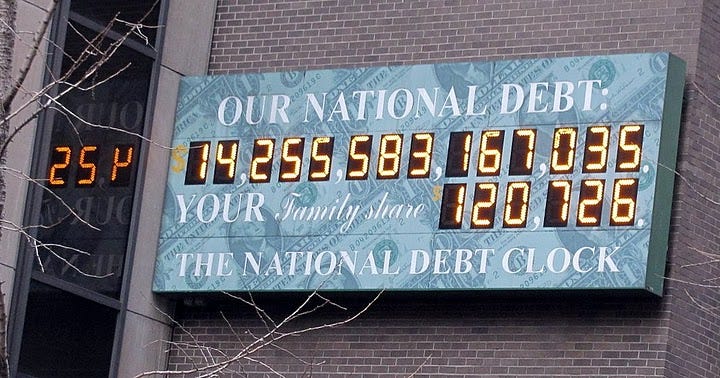
In that spirit, when the US national debt surpassed the $40 trillion mark last month, there was a smattering of news stories. The figure has more than doubled in the last decade while the Congressional Budget Office projects that total borrowing will reach $64 trillion in the next.
In isolation, these numbers are about as informative as monthly GDP figures. But US debt-to-GDP currently stands at a seat-shifting 125.8%. And while neither debts nor deficits appear to command much salience during the midterm elections, investors do care.
The US government cares too, particularly when 30-year Treasury yields hit 5.33%, their highest level since the eve of the Global Financial Crisis.
Yield to temptation
Why are borrowing costs so high? A quick and dirty bullet list:
The US runs large and persistent deficits — nearly 6% of GDP (even at close to full employment!)
Robust economic growth — projected to be 2% this year
Resilient inflation — hovering at around 3.4%, underpinned most recently by energy price pressures
Competition from the hyperscalers — even the US government has to compete with the tech giants for capital as they ramp up borrowing for data centres and other AI-related investments
A new Fed Chair — after a shaky start followed by reassuringly anti-inflationary noises at Jackson Hole, investors remain sceptical about whether the Kevin Warsh is too afraid of incurring the president’s wrath to ever raise interest rates
Uncertainty — over the pace of borrowing, over the policies of the Trump administration more widely, over the idea that the US will ever cut spending or raise taxes

To be clear, the market for US Treasuries is still functioning normally — this isn’t a buyers’ strike. The US dollar is still the global reserve currency and many buyers of Treasuries remain governed by mandates explicitly requiring them to hold the stuff.
Rather, the market is sending a clear signal — if the US wants to keep borrowing at these levels and if inflation stays this sticky, it’ll cost them. And it’ll also cost you.
Heads America wins, tails the world loses
US Treasuries act as the benchmark for global finance, providing the curve against which all other assets — government debt, corporate bonds, mortgages — are priced. Consequently, a sustained hike in yields has the nasty habit of drawing global capital into dollar assets, making it harder for everyone else to borrow, including the UK.