


“If you spent as much time on your Latin homework as you did studying old Arsenal matches…”
Parents say the darnedest things. It’s true, the merits of reeling off the 1971 FA Cup final line-up were not immediately obvious in 1999: Wilson in goal, Rice, McNab, Storey, McLintock (captain), Simpson, Armstrong, Graham, Kennedy (replaced by Kelly) and of course the match-winner, Charlie George.
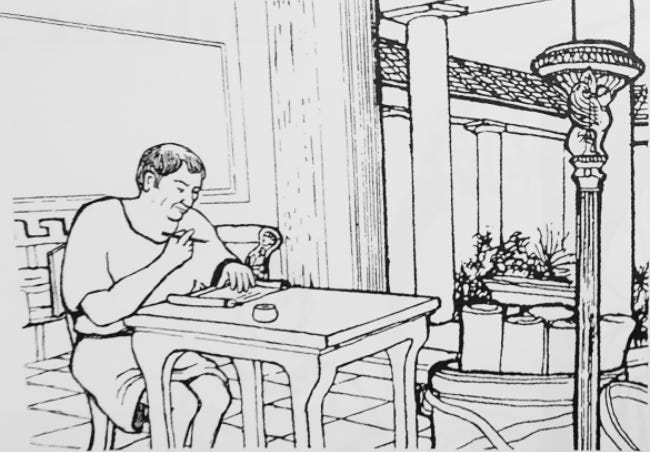
But in retrospect, I lean on these displays of geek bravado more in daily life than I do the near decade of knowledge acquired through Virgil, Horace and Ovid. Of course, Latin doesn’t start with the poets. Instead, like most fledgling classicists, we became acquainted via the Cambridge Latin Course and everyone’s favourite Pompeian slave-owner, Caecilius.
The guy was a banker, so why was he spending so much goddamn time “in horto est” (the garden). Clearly, working from home pre-dates the Covid pandemic.
It’s an algorithm
Learning Latin is more akin to mathematics than modern languages. Sure, you need to know what the words mean, but far more load-bearing are the formulas:
Declensions — how nouns, adjectives, and pronouns change their endings depending on their role in the sentence (case, number and gender).
Conjugations — how verbs change their endings depending on the person, number, tense, mood and voice.
These are extremely useful for translating Latin, specifically that designed for 13-year-old English schoolboys. They are functionally useless for middle-aged millennial Beagle dads. Worse still, they aren’t even much help when it comes to the stuff actual Romans claimed to read. Horace was a drunk, Virgil a propagandist while Ovid thought nothing of swapping a singular for a plural spelling just because it scanned better.
Believe me when I say this knowledge has landed me no job, earned me no social media clout and helped secure me precisely zero dates. It doesn’t even do anything for my University Challenge scores, where I consider six points a creditable result away from home.
Why hold onto grief?
So, why do I still know that “puella” is first declension, nominative, singular, feminine but that “templa” is second declension, nominative (and accusative), neuter, plural? Why do I know that “dirus” means dreadful while “dolor” means pain? Why hold on to grief?
Very occasionally, I get a hint of etymological satisfaction (from the Latin “satis” meaning enough). My favourite is probably placebo, the pill you swallow that has no strict medicinal value but can still make a patient feel better. Its literal translation is “I will please”. Also as a young child, I remember disturbing a grownup by guessing that the word “uxorious” had something to do with wifeliness (“uxor” meaning, you guessed it, wife).
But really, I cling to my declensions, conjugations and ablative absolutes not because they’re in any way useful but because they were so grimly tedious to learn that I’ll be damned if I’m going to let them slip. The jocks were right, Latin *is* a dead language.