



As is so often the case in our present microblogging dystopia, I was alerted to the discourse before I saw the actual news. The debate raging — largely in jest, I think — was whether Mark Carney could acquire UK citizenship, so that he might become British prime minister instead.
This followed Carney’s electric speech at the World Economic Forum in Davos — one that the UK’s sitting prime minister, Keir Starmer, would never have delivered. Amid Donald Trump’s demands for Greenland, Carney warned that "the old order is not coming back" and urged fellow middle powers to come together. As you can probably tell, I was rather pleased with what I came up with below:
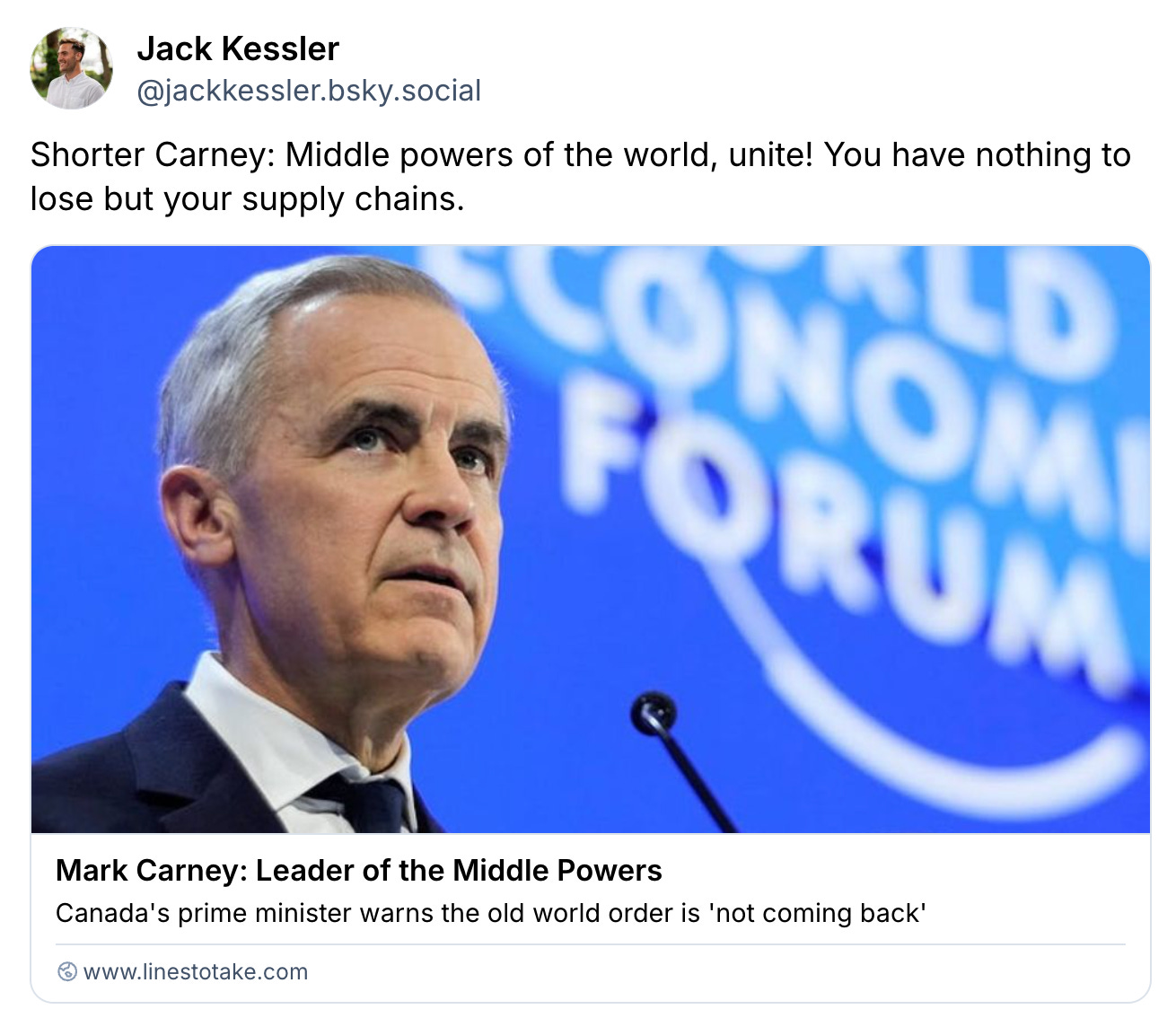
For various reasons, I have a fairly encyclopaedic knowledge of UK immigration law. But in this instance, Carney was born in Canada and obtained Irish citizenship in the 1980s before becoming a Brit in 2018 — fulfilling a promise he made when he became the first foreigner to be appointed Governor of the Bank of England.
Carney has since renounced his Irish and British citizenships, stating his belief that as Canadian prime minister, he should “only hold one citizenship.” Nevertheless, as a Commonwealth citizen, he is legally able to stand as an MP, so long as he has leave to remain in the UK. Which I’m sure could be arranged — unless Labour’s National Executive Committee tries to block him, Burnham-style.
Of course, the real reason why Carney delivered his Davos speech as leader of Canada, rather than Britain, has less to do with passports and more with the divergent interests of the two countries, when it comes to managing the United States.
There goes the neighbourhood
Carney’s rather languid pronouncement on the death of the rules-based international order garnered much media attention, and deservedly so. But something else struck me as equally important. Carney specifically described a world in which great powers were leveraging economic integration as weapons, explaining:
You cannot live within the lie of mutual benefit through integration, when integration becomes the source of your subordination.
He then went on to warn:
Hegemons cannot continually monetize their relationships. Allies will diversify to hedge against uncertainty.
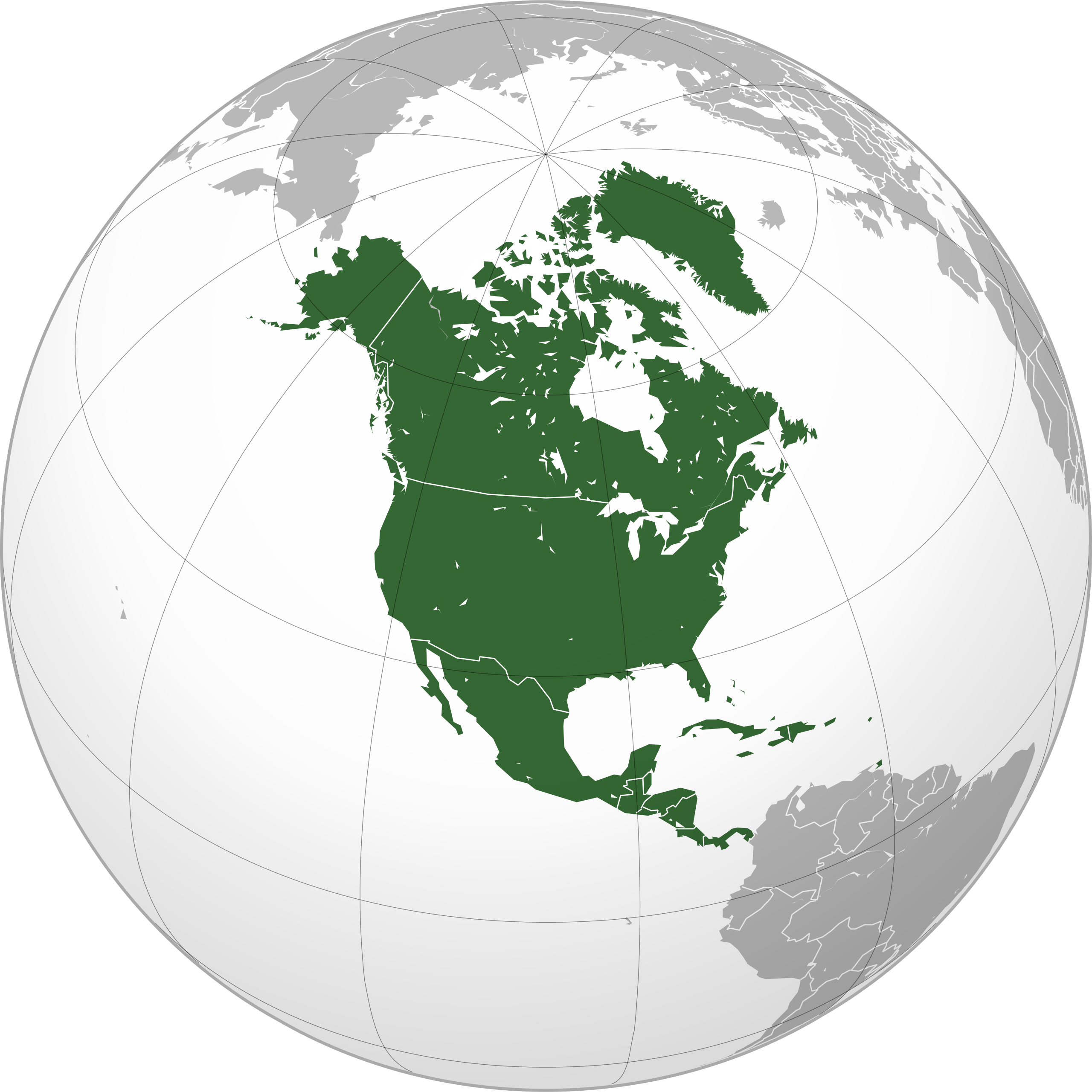
The hegemon to which Carney namelessly refers is of course the United States. And while America’s stunning descent from world-policeman-which-largely-plays-by-the-rules-because-it-wrote-the-rules to major source of economic coercion and supporter of territorial revisionism is bad for all mid-sized liberal democracies, it is a particular problem for Canada. To understand why, all one needs to do is look at a map.
The discovery of trade gravity
The US accounts for more than 67% of Canadian exports1, largely thanks to geography. The US-Canada border, spanning more than 5,500 miles, is the longest in the world, and commonly described as an “undefended border”, in that it is largely unmilitarised. And as Britain has had to painfully re-learn in recent years, trade gravity is a real thing2.
The US-Canada trade relationship, like that between the UK and the rest of Europe, has been built up over decades, from the 1965 Auto Pact to 1994’s NAFTA and 2020’s USMCA. Firms on both sides of the border have constructed entire business models assuming low trade friction which enables, for example, a car in production to cross the border multiple times before it is ever sold.
Then there is energy. Canada is the largest foreign supplier of oil to the US3, as well as a major exporter of natural gas, electricity, uranium, timber and critical minerals. There are the similar regulatory standards, common cultural practices and consumer preferences. And just a tonne of path dependency.
By contrast, the US accounts for around 16% of UK exports, with the EU far ahead at 41%. The US-Canada trading relationship is, economically speaking, simply more important to Canada than the US-UK relationship is to Britain.
And if you believe that integration is now a source of subordination, not strength, you need to do something about it, and might be prepared to tell the world about your plans.
A land far, far away
A US invasion of Canada remains unlikely4, despite Trump’s repeated suggestions that the country ought to become a “cherished 51st state”, and his obvious pleasure in referring to Carney’s predecessor, Justin Trudeau, as “Governor”5. But other middle powers are not feeling quite so comfortable.
Britain, Australia, South Korea and Japan may be less economically integrated with the US, but they are more highly dependent on the hegemon for their security. Consequently, leaders of these nations may be more willing to endure poor and erratic US behaviour, if that keeps the US engaged and, rhetorically at least, prepared to defend them from Russian or Chinese aggression.
Canadexit
It’s worth reiterating that collapse of the rules-based international order is pretty rough news for every mid-sized, liberal democracy. Carney is absolutely correct in his diagnosis, and the need for middle powers to work together. But that will itself be difficult, given that strategic interests will never perfectly align.
For Canada, the most immediate problem with the new America is economic. Trump is essentially performing a reverse Brexit on them6. For other mid-sized peers, who proportionately trade far less with the US but are more reliant on its security guarantees, the more important issue is keeping America onside for as long as it takes to do rearmament.
And that’s why, even if the UK could steal him away for a second time, British prime minister Carney would not have made the same speech that the Canadian one so eloquently delivered last week.
If that sounds like a lot (and it is), do note that represents the lowest non-pandemic level since the present method of data calculation was established in 1997
All other things being equal, an economy will gravitate towards trading with its closest neighbours
Canada accounts for roughly 60% of US crude imports
Yes, I typed that and now you’ve read it
Earlier this month, The Globe and Mail reported that the Canadian Armed Forces wargamed a US invasion, finding that the US would overwhelm the country “within a week and possibly as quickly as two days.”
Raising tariffs on Canada (and Mexico) being one of the first things Trump did on his return to office
Clear, thoughtful analysis. Very pleased you typed that a US invasion of Canada is unlikely. I trust your opinion.
In other news, are you building towards an article that is shorter than its combined footnotes? Just wondering
Jack, I have been commenting (many might say obsessively) for sufficient time to have formed a very positive opinion about the quality and range of your writing.
The slight problem+for me is that the migration to Substack seems more apparent than real. Many journalists who have columns in the mainstream media now post on Substack too. What I’m getting to is I feel your writing really deserves a more traditional audience AS WELL, via, say, a bi-weekly column in the print media. Has that become rather passé as an aspiration?
+ in that I am deluged by Substack invitations to subscribe & I am a poor chooser.