


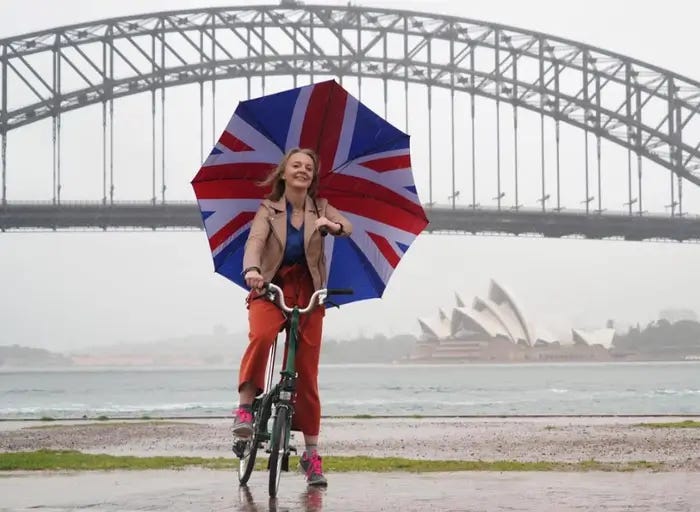
An ‘Australian-style’ immigration system. An ‘Australian-style’ Free Trade Agreement with the EU. An ‘Australian-style’ ban on social media for under-16s. British politicians are obsessed with Aussie-styles, to the extent that one is surprised not to see more moustaches and mullets in and around Whitehall.
The reasons for this rhetorical crutch are, I think, fairly transparent. Australia is ‘foreign’ without being threatening (Germany) or annoying (France). It is considered, at least from our perch, to be both well-governed and populated by numerous 90mph-plus bowlers.
And when it comes to migration, the comparison confers an air of toughness — partly because of Australia’s treatment of people who arrive by boat. Less well understood is that immigration per capita is higher than in the UK, with almost one-third of the population born overseas.
But I suspect that, when it comes to monetary policy, an Australian-style tightening might not appeal quite so much.
Australia takes a hike
The Reserve Bank of Australia1 (RBA) has raised interest rates for the first time since 2023, becoming one of the first major economies to do so. In a unanimous vote, the board reversed its decision to cut rates just six months ago, increasing the cash rate target by 25 basis points to 3.85%.
The culprit will be pretty familiar to anyone reading this: inflation. The RBA forecasts that inflation will reach 3.7% by the end of June (previously 3.2%) with it not returning to target (a range of 2 to 3%) until the middle of 2028. As to whether there would be further rate rises, Michele Bullock, the bank’s governor, said:
I don’t know if it’s a cycle. Certainly it’s an adjustment.
Which is the central banker equivalent of your parents telling you “We’ll see”.