


Why is the economy class experience so miserable, you ask yourself as you surf Skyscanner, select the 5.15am departure and haul small children to Luton? It is almost as if consumers’ stated preference — for more legroom, better food and friendlier service — differs from their revealed preference: flying at the lowest possible cost.
This — in addition to various bouts of deregulation — helps explain the rise of ultra low-cost carriers and the legacy airlines’ riposte, basic economy, in which nothing but the seat is included in the ticket price. And even then, there’s little space for all but the tiniest feet.
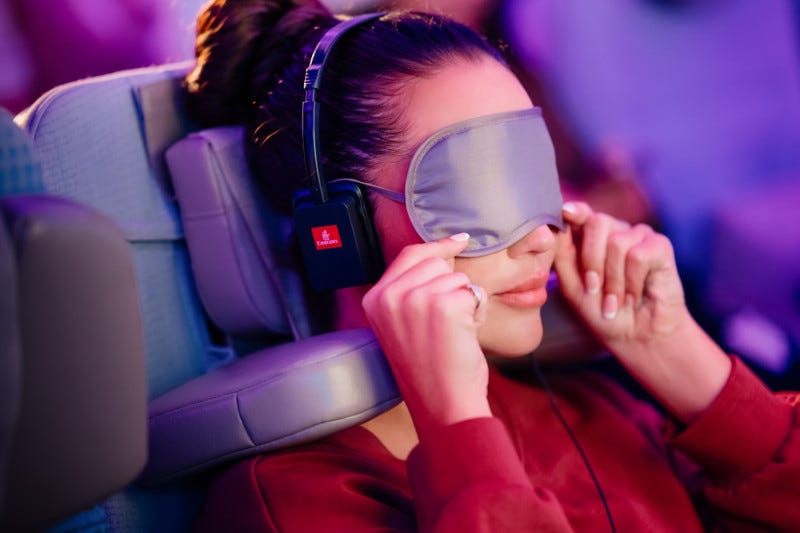
Which is why Emirates’ big new idea for economy class isn’t more legroom, but a fancier headrest.

Emirates likes to think of itself as different. Its business model (and despite the protestations of US airlines, it is not simply bankrolled by the UAE state) relies on its ability to command higher prices. That is, passengers choosing to fly with the airline, rather than with budget or full-service alternatives.
It manages this in a couple of ways. First, through its best-in-class entertainment system, quality soft product and global network. And second through its much-vaunted halo effect. In practical terms, people see the showers in first class and the bar at the back of business and assume surely some of that must rub off on a standard economy seat?
The big squeeze
Genuine innovation in economy class is rare, and Emirates is little different. As premium cabins have been embellished with doors and all-aisle access, the economy experience has, if anything, deteriorated. For instance, the airline’s older Boeing 777 aircraft, originally installed with a 3-3-3 (nine-abreast) economy class layout was later switched to the denser 3-4-3 (10-abreast) configuration.

This enabled Emirates to squeeze an additional 30-40 seats on board, at a cost of around 1.5 inches of shoulder width per passenger. But it also speaks to basic airline economics. The most lucrative seats are in premium economy and business class. As far as the typical chief commercial officer is concerned, the unwashed hordes at the back of the plane — replete with their tracksuit bottoms and neck pillows — are essentially providing little more than ballast.
Now, despite all my market research, which suggests that Lines To Take readers would really rather I wrote about British politics every day1, it was frankly unavoidable that I should opine on what Emirates is calling its “world first U-Dream headrest”.