


Do you remember where you were when Harry Kane took all six corners1 for England in their opening 1-1 draw against Russia at Euro 2016? At the time, this was seen as a strange, verging on subversive decision by manager Roy Hodgson. “I can't understand it… We need Kane in the box,” bemoaned former England midfielder Jamie Redknapp.
Never one to knowingly turn down the descriptive dial, the late Ray Wilkins said the decision “baffles the life out of me.” Alan Shearer, meanwhile, compared it to “asking Lewis Hamilton to change his own tyres.” The consensus view was clear: can’t someone else do it?
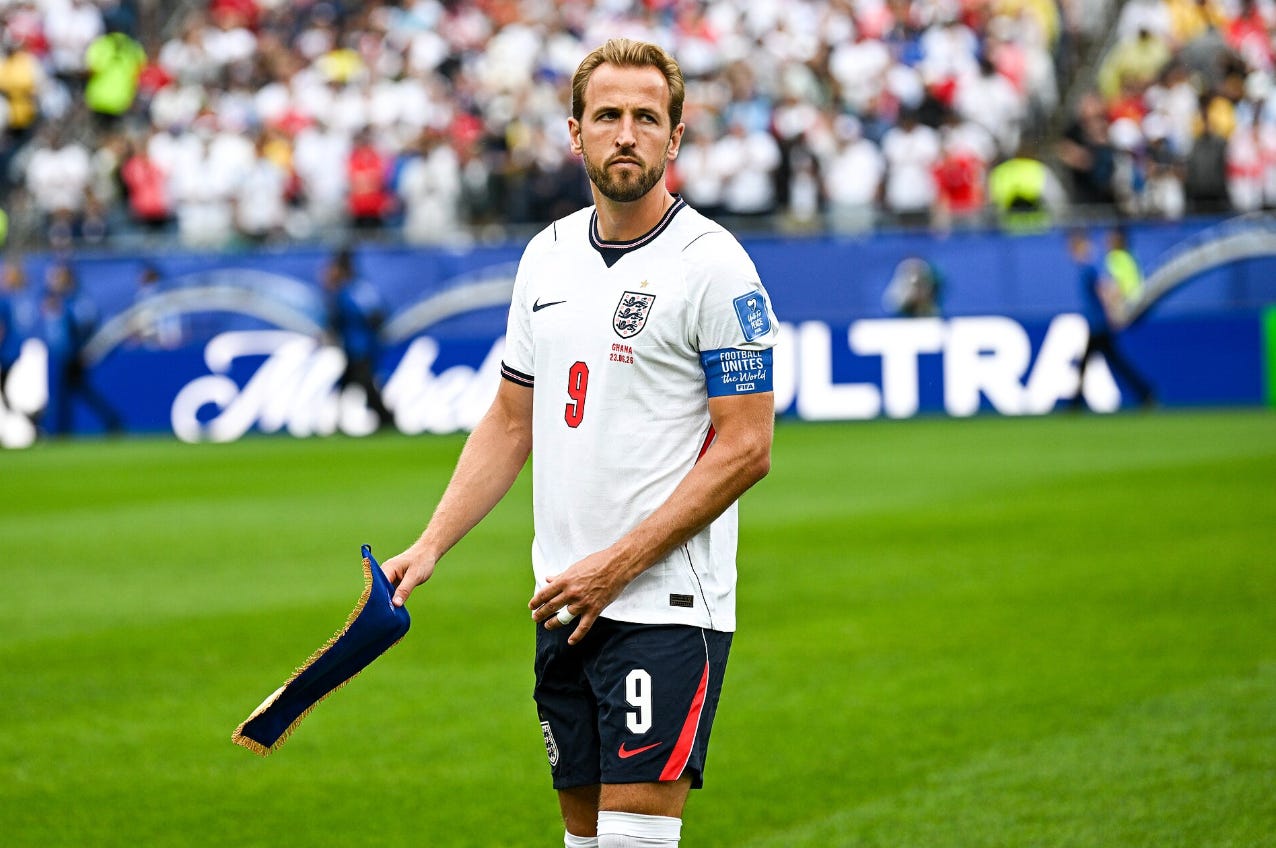
To be fair to the punditocracy, Kane took only seven corners for his domestic club, Tottenham, during the 2015-16 season, where midfielder Christian Eriksen was the designated set-piece specialist. And all seven of those Kane corners were taken short — that is, the ball was passed to a nearby teammate rather than lobbed directly into the penalty area.
Moreover, Kane was England’s main goalscorer. At an imposing 6ft 2in, surely he was better off trying to finish off crosses rather than take them himself?
Everything, everywhere, all at once
The problem for the likes of Redknapp, Wilkins and Shearer — but an even bigger headache for Hodgson — was that Kane was not only England’s best striker, but best everything. Had the manager enjoyed the option of fielding 10 Kanes plus a goalkeeper, he surely would have done so.

Fast forward to 2026 and Kane has been one of the best players in the world for over a decade. Not only a formidable goalscorer, but a player of incisive through balls, terrific link-up play, intelligent movement, anticipation, decision-making and pressing.
He combines the finishing of a traditional number nine with the passing range and awareness of a playmaker — and that may in fact undersell his abilities. I mean, in the Champions League last week, Kane took a goal kick because he’s the best at that too.
His value simply cannot be weighed in goals alone. And, oddly enough, that may have been holding him back.
Undervalued
At first glance, it might seem somewhat eccentric to describe a player who joined Bayern Munich for €100m2, earns an estimated €25m per year and has just won the Ballon d’Or as undervalued. Clearly, clubs, managers and chief executives get it. And yet, at 33 years of age, this recognition has been a long time coming.