


Imagine a semi-pro football team. Imagine their reserve team. Imagine their kitman. Imagine he resigned a decade ago. I’m the political version of that.
This is how Hopi Sen describes himself — and it is, of course, nonsense. Sen was head of campaigns at the Parliamentary Labour Party before becoming one of the sharpest and wittiest political bloggers of the 2010s. For today’s purposes, it was something he wrote during the 2015 Labour leadership election that struck me like a large limestone tablet with six election pledges carved into its face1.
That contest took place just weeks after a cataclysmic election defeat which few in the media and polling industry saw coming, but came as no surprise to the Labour candidates sent to knock on doors in the key marginals or, indeed, Scotland. A traumatised selectorate, exhausted by the compromises of government and empowered by the new rules which granted votes to ‘registered supporters’, saw Jeremy Corbyn secure a remarkable landslide.
Corbyn’s victory represented both a moral failure for the party and a political catastrophe for the prospects of a centre-left government in Britain. But to be fair to the membership, the other options did not exactly mirror those in the 1976 leadership election, in terms of political talent and cabinet experience2.
Andy Burnham was supposed to win3. The former Blairite-turned-Brownite-turned-darling-of-the-soft-left had carefully positioned himself as the most left-wing out of the mainstream contenders, including Yvette Cooper and Liz Kendall. Such a strategy came straight out of the Labour playbook, and a prime example of what Sen calls “one-stepping”:
To see someone saying something you largely agree with, but which others in your party do not, and to stand one step to their left and attack them for their heresy.
The problem with this gambit is two-fold. First, it is usually a one-way ticket to political irrelevance. And second, on this occasion, it didn’t even work. Because, as Burnham ought to have known, in the Labour Party there is always someone to your left. Indeed, the inclination of other candidates to engage in “one-stepping” is how Corbyn ended up on the ballot in the first place!
I’ve gone on about this at some length, partly because I think it’s interesting and partly because I don’t have an editor to tell me this was all self-indulgent throat-clearing. Today’s newsletter is nominally about Labour in 2026 and the extent to which the next leadership election, whenever it comes, will be an opportunity not only for one-stepping, but for what I’m calling EU-stepping.
That is, the contest will be a fight between candidates to be as pro-European as possible.
EU might very well think that; I couldn't possibly comment
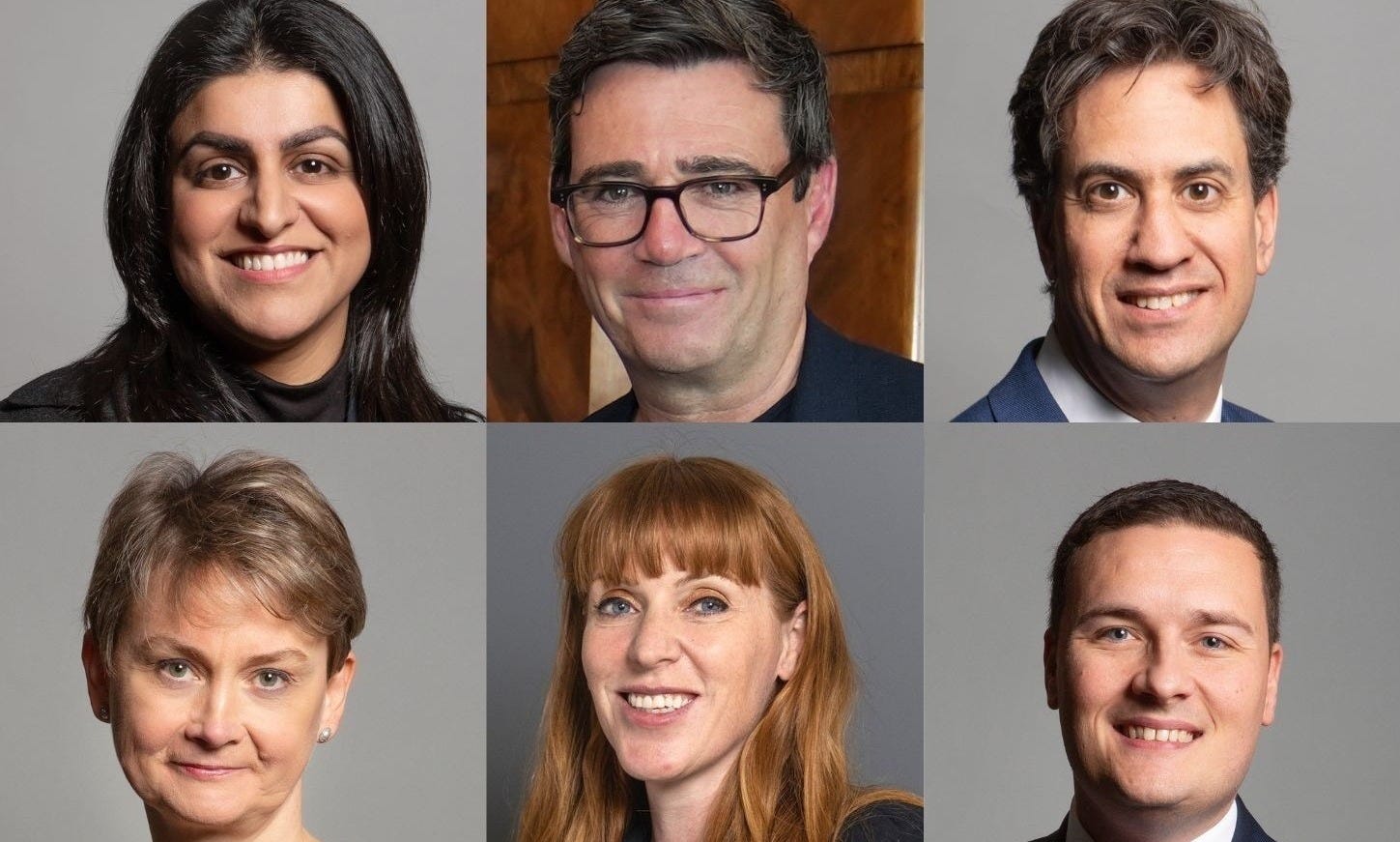
That there is no obvious or broadly acceptable successor is perhaps the single biggest reason why Keir Starmer remains in post. Each has their own shortcomings:
Angela Rayner’s tax affairs are yet to be resolved, with the former deputy leader awaiting the conclusion of an HMRC investigation into the underpayment of approximately £40,000 in stamp duty.
Wes Streeting is anathema to the ever-powerful (if not entirely uniform) soft-left, while the Health Secretary faces his own scrutiny over his political relationship with Peter Mandelson.
Andy Burnham — who is also the only potential successor to poll better than Starmer — is, famously, not in Parliament.
Shabana Mahmood — all other things being equal, voters assume women and ethnic minority candidates to be more left-wing than they actually are. In Mahmood’s case, however, her tough stance on immigration is unlikely to impress party members.
Ed Miliband is among the government’s most effective ministers and popular with party members for his work on Net Zero, but it is difficult to justify making someone prime minister who the voters rejected in 2015.
Yvette Cooper — the closest thing to a compromise candidate, for largely inexplicable reasons.
Al Carns — no matter how many times I see this name, I will never not think of former Conservative Welsh Secretary Alun Cairns. Which is probably a me thing.
But I think one thing is clear: as the candidates stake out their positions on Europe, expect to hear them out-bid each other, at a minimum, committing to rejoining the customs union, with others going further on single market membership. This would go well beyond current government policy, which is an EU ‘reset’ including negotiations over an animal and plant health agreement, joining the EU electricity market and emissions trading scheme4.